I am compiling ideas for my paper and decided to write it
down as a blog; I figured I was writing it down anyways, might as well do it
here. This will basically be a “working” outline for my paper. I usually don’t
do outlines, and just write and change things as I go, but for a 20+ page paper
I feel I may benefit from being a bit more organized. Plus any feedback would
be much appreciated (but not obligated). Also, I feel my presentation did not
go as well as I had hoped…ah well, what done is done. As Disney said, “Keep
moving forward!”
Soooo… my thesis… it is a working thesis... I am going to
explain in my paper how Shakespeare was influenced by Greek tragedies and Hamlet is a product of these influences.
The themes of the Greek plays especially those involving the characters Clytemnestra,
Electra, Orestes, Agamemnon, and Aegisthus echo throughout Hamlet. In particular, I plan on focusing on the character
Clytemnestra and how she manifests herself in Shakespeare’s character Gertrude.
The link between these two characters provide support that Gertrude was at the
very least involved in the plot to murder the king. I also plan to gain support
with Iris Murdoch’s novel, The Black
Prince. Like Agamemnon, Murdoch’s character Arnold commits adultery. When
his wife, Rachel, finds out, she is driven to murder. I plan to use this as
evidence that like Clytemnestra and Rachel, Gertrude was driven to murder her
husband, Hamlet, Sr.
Obviously I need to clean this up a bit, but I think this is
the direction I want to go in.
I plan on added textual evidence from Hamlet that mirrors the Greek characters. I have found several
critical essays that support the theory that while Shakespeare may not have
been able to read Greek, he did have many scholarly friends which may have led
to detailed discussions involving Greek plays and their intriguing characters.
As a writer there can be no doubt that Shakespeare would have been interested
in these subjects.
The other essays I have found will focus on Gertrude’s
motives as a woman during that time period, as well as those motives shared by
Clytemnestra. I feel there is enough said (and not said) to support the theory
of her involvement. The article titled Queen
Gertrude: Monarch, Mother, Murderer states the theory that Gertrude uses
indirect aggression to achieve her goals. Indirect aggression is a form of passive
aggression. It happens typically when a person rebels against another person, a
person typically in a placement of high authority. A person who uses indirect
aggression usually uses it when they feel powerless in a situation. This theory
fits perfectly with all three of the female characters I wish to focus on,
Clytemnestra, Rachel, and Gertrude. All three are in submissive roles in
society and are victims in their own right. Because of the textual and overt
admission of guilt in Clytemnestra’s case, the seemingly obvious witness to
Rachel’s guilt, it leads the reader to believe that Gertrude must be guilty as
well, even though there is no direct textual evidence and only circumstantial
evidence.
I hope this will come together as nicely as I picture it in
my head. I am excited to prove Gertrude guilty, even though most critics believe
she is innocent. I feel there are too many gaps in her story for us to make
sound judgment. I feel there is enough said and not-said to support my theory,
and the theory of a few other critics. Plus, I do enjoy playing the devil’s advocate.
Iris Murdoch’s
cleverness is beyond the scope of this blog post and its author is inadequate
to demonstrate how great Murdoch’s novel is as a work of art. However, I can
write that Murdoch provides her reader with much to think about with many
intertextual elements to mine, as well as creating a work that meets her own
definition of great art.
Murdoch
(Against20) writes that great art
does not console but rather “helps us to recover from the ailments of
Romanticism.” These ailments include “dryness,” the residue of Romanticism
after the “messy” humanitarian and revolutionary elements have spent their
force. This means the loneliness of rationality and “freedom” (Against18), together with “a dangerous lack of
curiosity about the real world, a failure to appreciate the difficulties of
knowing it” that is induced by a “simple-minded faith in science, together with
the assumption that we are all rational and totally free.”
The Black Prince is not a novel that
falls to the temptation of consoling the reader. The narrator, Bradley Pearson,
is not completely rational in his relationships with any other characters in
the novel. Murdoch seems to bring her
characters to the edge of reason (and, in the case of Priscilla, beyond it). In
Murdoch’s novel, the world is unstable, unpredictable, difficult to know, and
no one seems in control with the freedom to make choices in their own
self-interest. Bradley is unable to go to Patara
or to write; Arnold is unable to resist Christian; Francis is constantly
inebriated and broke; and Rachel cannot keep her hands to herself. Furthermore,
the irony of the novel is that Bradley Pearson’s work of art that he
successfully writes, his “‘art object’” (72), is about the failure of his life
(Baschiera). It is difficult for the reader find consolation in this
conclusion.
In
addition to adhering to her own principles of great art, Baschiera (48) writes
that Murdoch’s novel also “takes advantage of stock incidents and devices
traditionally belonging to Elizabethan theatre.” Examples of these incidents in
the novel include a cross-dressing Julian, Arnold’s letter received by Bradley
and read by the wrong person (Rachel), a character playing the fool (Francis),
among others. The novel also includes elements of Shakespeare’s Hamlet. Bradley shares Hamlet’s
inability to act, and when he does act, it is sometimes rashly. The novel also
borrows from Hamlet the idea of
constantly keeping the audience on edge, rather than letting them settle into a
predictable narrative. The situation in which Bradley finds himself is
constantly changing, and the more he tries to control it, such as trying to
prevent Arnold from having anything to do with Francis and Christian, the more
out of control it becomes.
These
allusions to Elizabethan drama and borrowings from Hamlet contribute to what Sanders (25) calls an “inherent sense of
play, produced in part by the activation of our informed sense of similarity
and difference between the texts being invoked, and the connected interplay of
expectation and surprise, that...lies at the heart of the experience of
adaptation and appropriation.” Murdoch seems to play consciously with the
elements of drama and weave them into The
Black Prince. It seems that Murdoch intentionally “misreads” and
“misprisons” the work of Shakespeare’s Hamlet
(Bloom). This ability of Murdoch’s, to take Shakespeare and re-imagine elements
of it into a different generic form, is another aspect of her work that makes
it recognizable as great art.
If
it is assumed, and I confess that I do, that Murdoch’s opinions on great art
are worth considering and applying, and that her ability to capture and rework
elements of Shakespeare into The Black
Prince is part of the pleasure of reading it, then The Black Prince is an example of great art. Besides, would you
argue with this (Murdoch’s) face?
nndb.com
Works
cited:
Bloom, Harold. The
Anxiety of Influence: A Theory of Poetry. New York, Oxford UP: 1973; 2nd edition, 1997.
Dente Baschiera, Carla. “Re-Inventing Ambiguity in the 20th
Century: Iris Murdoch’s The Black
Prince.” Textus 11.1 (1998): 45-64.
On page 152 of The Black Prince, Bradley and Julian
discuss Gertrude’s involvement in the King’s murder from Hamlet. Julian feels that Gertrude may have had a hand in the murder
with Claudius. She also expresses the idea that Gertrude and Claudius may have
had an affair prior to the king’s murder. She states, “I think some women have
a nervous urge to commit adultery, especially when they reach a certain age”
(Murdoch 152). This hints at the possible link between Gertrude and Julian’s
mother, Rachel.
Bradley feels Gertrude is definitely not involved in any way
with the murder and did not have any previous relationship with Claudius.
Bradley feels Hamlet is Shakespeare (see pages 185-195) and that Hamlet had an Oedipus
complex and was a homosexual and involved romantically with Horatio. Bradley
quickly dismisses anything negative with Gertrude, likely because of his obsession
with his own mother. These Hamlet interruptions in the novel mirror the plotline
and foreshadow what is to come. Julian asks, “Why couldn’t Ophelia save Hamlet?”
which Bradley responds, “Because, my dear Julian, pure ignorant young girls
cannot save complicated neurotic over-educated older men from disaster,”
(Murdoch 188). This of course foreshadows Bradley’s demise at the end of the novel,
something Julian could not prevent.
Of course, with my adamant feelings regarding Gertrude, I
feel Murdoch would agree with me on Gertrude’s involvement in the king’s
murder. Sure Bradley disagrees, but Murdoch obviously fashioned Rachel to
mirror Gertrude, and Rachel is manipulative and conniving and self-preserving
at all and any cost. She even states that “I won’t save [Arnold, her husband,]
at the end. I’ll watch him drown. I’ll watch him burn” (Murdoch 33). I feel it
is pretty clear that Rachel is a smart, strong woman, which the very same can
be said about Gertrude. Gertrude had her own power, and I feel she used that
power to allow and influence the downfall of a king.
Throughout the novel, The Black Prince, I wholeheartedly
believed what Bradley told me. As the reader reading a tale in first person I
felt I had to believe him. In lying to me he would be lying to himself, and
what type of person would do that? I sure wouldn’t! At least not intentionally.
There were several times in the novel where I found certain facts a little
difficult to believe, the most important would be how Bradley had all those
women just begging to get in his pants. He’s self-described and interpreted by the
reader as a bitter old man. He describes himself as “thin and tall, just over
six feet, fairish and not yet bald, with light fine silky rather faded straight
hair. [He has] a bland diffident nervous sensitive face and thin lips and blue
eyes” (Murdoch 15-16). That description does not sound very tempting to me, but
apparently Rachel (a married woman), Christian (his ex-wife), and Julian (a naïve
young woman) just can’t seem to get enough of him and are willing to risk
anything and everything to be with him…not to mention Francis hits on him and
constantly ties to convince reader and Bradley that Bradley is gay. Bradley’s
manic personality change when he falls in love with Julian is also
disconcerting to the reader…is he crazy or is he sane (a very Hamlet-like
confliction).
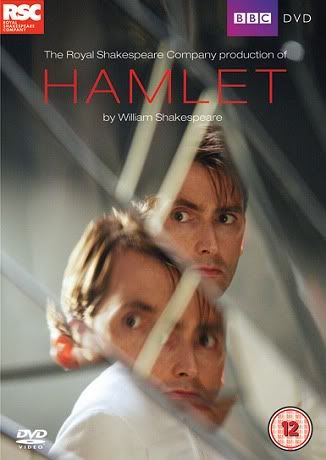
(I like this photo of Hamlet—it shows his shattered self well)
However, it is in the postscripts that I completely lose
faith in Bradley’s reliability. He admits that during the trial of Arnold’s
Baffin’s murder that (under oath!) he changed his story over and over again: “As
the time went on I tried various attitudes, said various things, changed my
mind, told the truth, then lied, then broke down, was impassive, then devious,
then abject…Perhaps at moments I almost believed that I had killed [Arnold],
just as at moments perhaps [Rachel] almost believed that she had not” (Murdoch
374).
It also doesn’t help Bradley’s case that Christian causally
discredits him at every turn and Rachel belittles his every account. Julian,
possibly the one person the reader could rely on chooses instead to state she
cannot accurately recall the change of events that transpired. The readers are
left to decide for themselves. Personally, I want to believe Bradley, but I do
not feel he’s told me the whole truth…
Once again, this novel is confusing me- it just doesn't feel like a Hamlet offshoot.
I guess what I'm trying to say is that these novels are not what I expected. When I heard that we would be reading novels that were the aftershocks of Hamlet, I thought we would be seeing retellings and observing how the plot elements were reused and altered, it's genesis and journey to the modern era. What I seem to be getting is a series of sad novels that reference Hamlet as a model for the misery they are trying to convey.
I really wonder how much The Black Prince would have actually been affected if Hamlet were never written. Would the events play out pretty much the same, only they would be discussing and referencing some other supposed greatest work? And what would that be? Is the real finger print of Hamlet here that of the unique character? Is there another person in all of literature that could replace Hamlet's role in this story.... You know, I think there isn't. Maybe that is what I should be focusing on.
There are plenty of other Hamlet like flavors: people haunted by their past and future decisions, plots, violence, murder, imprisonment and banishment. Still, I keep arriving at the same hang up. Shakespeare didn't invent ghosts, death, vengeance or banishment. He arranged them in a way... In a way some people argue has already been done. So what's here, really? The story is once again missing the central plot point: Bradley isn't seeking vengeance for a dead relative. He's seeking quiet study. All the other elements are as old as the beginning of the human drama. Shakespeare's only unique contributions to the play lay in beautiful words and a singularly complicated character. I wouldn't call Murdochs writing exactly beautiful. It's a bit blustering, long winded and it show boats. But Bradley is almost complicated enough and almost true enough to be a spiritual successor to Hamlet
One of the articles we had to read was talking about how it would silly to assume that Hamlet was a weakling. And while I don't assume he was a weakling at all, I do believe he was something of a coward. He spends so much of the play in a state of inaction. He refuses to do anything. He decides instead to sit and think, and over-think what he's going to do with the information of his father's death and then the identity of his father's murderer. Hamlet talks a big game but doesn't really do anything about it for 5 acts. I feel like he's actually a very strong character to fully think about whether or not his father's ghost was a true vision or if it was a bad omen from Hell, and he is strong in the sense that he does not completely break from the news of his father's death. But this doesn't mean that he's not a coward.
Hamlet spends 5 acts going back and forth trying to decide if he's going to kill Claudius and when he's going to kill Claudius, and how he's going to kill Claudius, but he never really acts on it until he knows it's his last and only chance. He sits around and sulks and doesn't talk about what's happening internally and doesn't act upon what's happening internally. It seems like he is so worried about the repercussions and what could potentially happen after the fact that he's too afraid to actually do anything. He makes excuses all the time, saying he won't kill Claudius until he knows through Claudius himself that he's the murderer, not just from hearing it through the lips of a ghost. And then he can't kill Claudius when he is in his grasp because Claudius is in a church so he'll go to Heaven if I kill him now. Only when he is dying does Hamlet finally take a stand and kill Claudius. But that doesn't make him any less of a coward. That just continues the idea that he is one. He is only willing to kill Claudius when he knows nothing will happen to him for doing so. Nothing worse can happen to him than Death--I'm sure he doesn't believe he's going to end up in Hell.
Meanwhile he's willing to kill Polonius from behind a curtain. I feel like this is another sign of his cowardice. He cannot see Polonius and Polonius cannot see him, it seems like there will be no repercussions from this killing (though in actuality I'm sure Polonius can surmise who stabbed him, and Gertrude witnessed it). He can also indirectly kill Rosencrantz and Guildenstern, because all he has to do is intercept a letter and send a new one. He doesn't have to spill any blood. Same with Ophelia. He plays a hand in her death but it doesn't seem to weigh on him as much as the idea of killing Claudius does because, well, Hamlet didn't push her into that pond. In every death Hamlet is responsible for, he performs them with such cowardice. It makes me almost mad that a man who is supposed to avenge his father and who could have taken over the throne and one point can't even gather up the courage to kill his father's murderer until it's almost too late.
Intertextuality is a tricky term to get your
head around. I think there are two ways to view intertextuality. The first is
Bloom’s approach – that is, the influence of predecessors can be a source of
anxiety for the artist. The artist is influenced by artists that have already
made their mark, whether they want to be influenced by them or not. Sometimes,
even by actively attempting to avoid the influence of those who came before,
the work of an artist is nevertheless “contaminated” by the greats of the
canon. The second view is summarized by Sanders. Sanders (17) tends to
celebrate intertextuality in a way that allows the artist to freely rethink and
redeploy the work in the canon and interprets such intertextuality through the
lens of post modernism and the post-colonial notion of “hybridity.” Each
approach began with the work of T.S. Eliot, in his famous essay, “Tradition and
the Individual Talent,” first published in 1919.
According to Eliot
(406), writing in 1919, “No poet, no artist of any art, has his complete
meaning alone.” Each artist must be set among his or her predecessors and
attitudes toward it “readjusted” as the “past should be altered by the present
as much as the present is directed by the past.” The way we view artifacts
produced in the past is influenced by what is created by the contemporary
artist. Furthermore, Eliot suggests (407) that “the poet must develop or
procure the consciousness of the past and that he should continue to develop
this consciousness throughout his career.” I think this means that art is not
created in a void – it is created against the backdrop of what has come before
and finds its context within this pre-existing framework: “impressions and
experiences combine in peculiar and unexpected ways” to form new works of art (409).
Bloom develops
this idea further from the 1970s onward. According to Bloom (xix), “great
writing is always at work strongly (or weakly) misreading previous writing.” “Misreading”
means the reading of a text in new ways by artists. This can lead to a certain
amount of anxiety in artists as they attempt to work around the influences that
precede their work. Bloom (xxiii) calls this an “anxiety of influences.” This
means that all writers “misread” the work of their predecessors. As a consequence of this, writers poetically
and creatively interpret, or “misprison,” the work of their predecessors, even
if they do not intend or want to do so. “Misprisonment” means writers resurrect
elements of the work of those that have influenced them. It is in this way,
Bloom’s (xxiv) claim is that many authors have been and continue to be
influenced by Shakespeare. He even goes so far as to call it “this horror of
contamination” when related to Ibsen, who apparently loathed Shakespeare’s
influence. Bloom (xxv) encourages the reader to develop an “awareness of the
anxiety of influence” with regards to Shakespeare so that we might get over resenting
it.
Sanders, writing
more recently in 2006, has a different perspective to that of Bloom’s. The term
“intertextuality” is actually used by Sanders (17). Sanders attempts to explain
the meaning of the term as it is currently used by defining its parts: “adaptation”
and “appropriation.” There are three types of adaptation: the first is
transposition (a screen version of a novel), the second is commentary
(adaptations that comment on the source text), and thirdly, analogue (a
stand-alone work where knowledge of the source text is not essential but such
knowledge may “enrich and deepen our understanding of the new cultural product”
(22)).
Another part of
the meaning of the term “intertextuality” is appropriation. Appropriated texts
are not as clearly acknowledged as adapted texts. There are two broad
categories, according to Sanders (26), of appropriated texts: embedded texts
and sustained appropriations. Embedded texts are more than adaptations, where a
film version of a novel is still, in essence, recognizable as the same story.
An embedded story is a “wholesale rethinking of the terms of the original”
(28). West Side Story is an example
of an embedded text with Shakespeare’s Romeo
and Juliet being reimaged in a 1950s New York City setting. I think that Sons of Anarchy, as mentioned by Tom, could
also be an example of an embedded text.
Sustained
appropriation can be discovered through “examination of sources or creative
borrowings, citing allusions to or redeployments of” the work of predecessors.
It is up to the reader to trace the relationship between a new text and what
may have influenced the new text (34 -5). Our study of Dickens’ Great Expectations helped us to identify
the original materials of the “bricolage”
(17) – similar, I think, to Eliot’s (409) idea that the artists “impressions
and experiences combine in peculiar and unexpected ways” – and that kind of
study forms part of the pleasure of reading a text for the reader. Furthermore,
the artist, from this perspective, is free to embrace the act of creating an
intertext, rather than be anxious about it, as Bloom suggests.
I think that
identifying influence or intertextuality is what good readers do, without prompting.
A good reader is always looking for connections to other texts, ideas, and the
real world. Knowing this process has a name lends formality and legitimacy to
the process. As Allen (6-7) suggests, in comparing a text by authors we read
with those that may have influenced their work, we may arrive at a different
perspective on each of the texts, old and new. Every reader will take something
different away when working through this process. The important thing is that
working through this process when reading makes us pay attention.
Works cited
Allen,
Graham. Intertextuality. 2nd
edition. New York:
Routledge, 2011.
Bloom,
Harold. Preface. The Anxiety of Influence: A
Theory of Poetry. New York, Oxford
UP: 1973; 2nd edition, 1997.
Eliot,
T. S.. “Tradition and the Individual Talent.”
Criticism: Major Statements. Ed.
Charles Kaplan and William Davis.
Boston: Bedford, 2000. 404-410.
Sanders,
Julie. Adaptation and Appropriation.
New York: Routledge, 2006.
I was planning on making this blog post much earlier, however the complexity of the Sons of Anarchy delayed it. Far from being "Hamlet with Motorcycles," the Sons of Anarchy is a complicated meditation on American outlaw culture. Hamlet simply acts as a wire-frame to contemplate the larger issue on what exactly happened to the idealism behind the 1960's rebel outlaw, to the more violent modern image that we know. In other words, Sons of Anarchy is more asking the question "How did we become an 'Easy Rider' to a 'Son of Anarchy,' letting go of idealistic fancies to a colder, darker, more violent realization?"
For the uninitiated, the 1969 movie "Easy Rider" captured the spiritual ideal of an entire generation. By presenting the emerging counter-culture in a positive light, "Easy Rider" was a mega-smash hit of it's time and spoke to the soul of the generation of the time. Peter Fonda and Dennis Hopper starred as two outlaw biker drug-runners, blazing a trail on the road in a search for the American dream. The two characters represented freedom in all of its entirety, cruising through the culture in search for America's ideal.
http://www.youtube.com/watch?v=Cfk4Bqub2Eo
(This is honestly one of the coolest movies ever please go watch it)
Now, the FX series Sons of Anarchy uses both Hamlet and "Easy Rider" as a starting point for it's narrative. The individual story takes direct clues from Shakespeare's Hamlet, introducing the audience to the fictional small town of Charming, California. In the microcosm of Charming, an outlaw gang of motorcyclists known as the Sons of Anarchy rule the town. The Sons (also referred to as 'Sam Crow') are, for all intents and purposes, the ruling body of Charming. They control a lucrative gun-smuggling ring and keep the small-town safe from the more damaging aspects of criminal life.
The reason why the Sons of Anarchy command so much respect, and tolerance, by both the local law enforcement and general population of Charming, lies in their ability to keep drugs, prostitution, and corporate chains out of the small town. The Sons command respect and loyalty within the town because they're able to safeguard the people of Charming from corporate chains and hard crime.
In a way, the Sons are their own little kingdom; there is a whole system of politics, ranging from small business owners to the local police force, that makes up the motorcycle gang's power. Charming, California, is it's own little kingdom; ruled by the ne'er-do-well's of motor-cycle outlaws. The series starts out well within this balance, modelling the structure of an outlaw gang with a direct monarchial rule.
Now, you may be asking, "what in any of this have to do with Shakespeare's Hamlet?"
The answer becomes all too apparent from the very first episode. The entire show of Sons of Anarchy starts within the bare-bones of Hamlet. Jax Teller, the son of the founding "First Nine" member John Teller, celebrates the birth of his own son. Jax's ex-wife is a drug addled crazy-woman, driven to substance abuse and psychosis due to his own terrible behaviors as a man. Jax's mother, Gemma, is happily wed to another "First Nine" founder Clay, the latter having completely taken over the Sons of Anarchy in nearly all regards. Clay calls all the shots, and makes all of the decisions, for the outlaw gang.
(Pictured above, Jax Teller: The Hamlet of our story.)
At the beginning of the series, Jax is at peace with the whole set up of the Sons of Anarchy. He is totally accepting of the fact that his own mother, Gemma, is the "Old Lady" of Clay. He's even cool with the fact that his father died under mysterious circumstances. Nothing seems to bother Jax much, until the birth of his son--in which Jax begins a bit of introspective, soul-searching exercise.
By chance, Jax uncovers the type-cast for a novel that his father, John Teller has written. The title of the typecast is The Life and Death of Sam Crow: How the Sons of Anarchy Lost Their Way. The type-cast details the entire manifesto of John Teller, explaining the underlying 1960's ideals that founded the Sons of Anarchy as a motorcycle club.
As each episode progresses, John Teller narrates on how the Sons were supposed to be something radically different from what they are under Clay's leadership. The Sons were supposed to be a "Mobile Commune," free-spirited and unbound by traditional law, encapsulating the peace and liberty of the 1960's. John Teller's original vision for the gang was the very image of what Peter Fonda and Dennis Hopper portrayed in "Easy Rider," spreading the hippie ideal of the free spirit.
As the series progresses, Jax learns of his dead father's ideals through the novel-script he left behind, slowly becoming "haunted" by it. His mother, Gemma, even elaborates on this fact in direct dialogue; speaking to her lover Clay on how the "ghost" of John Teller is haunting Jax from beyond the grave. More so, the interaction between Gemma and Clay hint at a larger betrayal; whatever happened between John, Gemma, and Clay, it becomes apparent that the latter two had set up the former in a grand grab for power. In other words, it is strongly hinted at that Gemma and Clay conspired to seize power from John, to guide the Sons of Anarchy in a more profitable, violent, criminal direction.
(Ron Perlman and Katey Sagal as "Clay" and "Gemma," AKA the "Claudius" and "Gertrude" figures)
As the series progresses, the main character Jax becomes more and more disillusioned from what the Sons of Anarchy has become. Referenced as "the prince" of the club multiple times, he begins to move more and more away from Clay's authority, plotting his own path for vengeance. Gemma and Claw become aware of this fact, and fight to try to find a way to cover up the dirty secrets of their past--to no avail. Slowly, Jax listens to the words written in his father's novel, to plot his own revenge against the two people who guided the motorcycle club into a darker path.
Yet, the series itself deals with a whole mess of other issues that stretch far beyond Shakespeare's Hamlet. This is not a simple revenge-narrative, but more a contemplative look at how the ideals of outlaw culture clash against the cold, brutal reality.
How exactly did we go from being "Easy Riders" to "Sons of Anarchy?" Why did the free-spirited hippie have to delve into the darker, more violent, side of life? How can a man both protect his family, while seeking to destroy what it has become? When you're living on the edge of society, how can you hold up higher ideals?
The Sons of Anarchy asks all of these questions, and more, taking the traditional Shakespeare narratives to new directions. While the series starts off in the very familiar Hamlet territory, what transpires between each season asks larger questions on American counter-culture. While we can draw direct parralells between characters (Jax is Hamlet, Gemma is Gertrude, Clay is Claudius, Opie is Horatio, Tiggs is Palonius, Tara is Ophelia, etc etc.) the series takes the form of Hamlet into radical, modern directions.
Where it leads I cannot say--I'm still in season 4 of the show itself. I have not completed it.
However! I can say that it is a very entertaining show, and worth anyone's time.
Hamlet is an
important play in western culture and has influence in many countries (Bloom). Some
English critics and actors have done a great deal to promote Hamlet within the Shakespeare Industrial
Complex (S.I.C.). The continued perpetuation of the S.I.C. from the seventeenth
century to the present day keeps a lot of academics and theatre companies in
business. It is up to the individual to decide if Shakespeare is really that
good or if we think it is good because a lot of stakeholders in Shakespeare
drama have a strong interest in saying so.
Bloom (81) presents the case that, during the eighteenth
century the Shakespeare Industrial Complex was well underway. This is because, “such
a concentration of dedicated textual critics has never been seen since, and
their efforts helped to turn Shakespeare into England’s preeminent literary
genius.” Critics such as Pope, Steele, Dennis, Warburton, and especially Johnson,
contributed. Of Hamlet in particular, “Farquhar called the play ‘long the
Darling of the English Audience, and like to continue with the same Applause.’”
Indeed, the intensive adoration of Shakespeare from the 1760s onward was so
great that R.W. Babcock called this period the “Genesis of Shakespeare Idolatry”
(85).This may indicate that Hamlet is
a great play because a lot of English critics said it is great.
Not only critics contributed to the S.I.C and Hamlet’s role within it.
Actors such as Betterton and Garrick, who played the Danish prince, were loved
by their public. Each actor benefited from Hamlet. Garrick, in particular, found the promotion of Shakespeare
in terms of a jubilee celebration in the town of Stratford, to be worth his
effort as he amassed lots of money as a Shakespeare actor. He also contributed
to the S.I.C. through supporting the careers of younger Shakespeare actors and
the preservation and the making accessible early versions of Shakespeare (Bloom
85-6). This kind of promotion of Shakespeare not only helped Garrick but also
most likely helped cement the S.I.C.
In the eighteenth and nineteenth centuries, the S.I.C expanded
in new ways. Hazlitt “redefined assumptions about what makes a great tragic
hero” (Bloom 137). Coleridge shifted the focus of Shakespeare’s
characterization from sensibility to philosophy (138). The tenor of critical
focus on Hamlet’s mental state became more technical as psychological study
developed as social scientific field (139).
There are many arguments floating around as to the reasons
behind Shakespeare’s immortality. Some would argue that Shakespeare is great
because of the seemingly explosive and magical combinations of words that he
used. Or perhaps it is his representations of evil, that are irresistible at
times and revolting at others. It could be his ability to mine the human soul
for material that makes him great. However, it is sometimes overlooked that not all of the English were so enamored by Shakespeare’s work. A critic (perhaps Thomas Hanmer) attacked Hamlet for having no good reason to delay his revenge (Bloom 82). Some European critics definitely found Hamlet wanting. Voltaire dismissed Hamlet as a “gross and barbarous piece” (Bloom 83). This could be considered European playwright envy, but this Continental criticism may also have some merit. This indicates again, that perhaps Hamlet is considered good, in part, because a group of English critics said so.
It cannot be denied that Shakespeare is an extreme example
of a playwright. Neither can it be denied that there are many stakeholders in
the business of Shakespeare to the present day. There may be more than even in
the seventeenth century, when every Shakespeare academic, high school English
Literature teacher, actor in companies large and small, is accounted for across
all continents. Maybe it is Shakespeare’s inherent greatness and the
accompanying Industrial Complex in combination that will never let us forget him or his work
and will ensure our discussion of it into the future.
So I've been diligently reading away at Great Expectations, and I admit to a great deal of confusion. I'm failing to see how Hamlet influenced it - at least so far. Perhaps I have just not come to that place in the novel, but I seem to be missing the point. Anyone else in this boat?
I am not missing the influence of Shakespeare in this work. His fingerprints are all over it, from direct references to more subtle touches: in characters and plot points. However, the references seem more like Macbeth to me. I see Pip scrubbing blood from his hands and contemplating his guilt, and I hear Lady Macbeth shouting 'Out out, damned spot!'
Shut up... it's cute and kind of related .
The main elements of Hamlet, at least as I see it, are being haunted by the ghosts of the past, of seeking vengeance, and of a constant struggle between the intellectual mind and the emotional heart. I see so little of these traits in Great Expectations. One might argue that Pip is 'haunted' by the action he took in aiding the escaped convict when he was a child - but at least some of these events were, in part, beneficial to Pip - resulting in his new fortune and so on, for all that it was mismanaged.
Did it occur to anyone else Pip would have had a much nicer life if he became a blacksmith and told Estella to hit the road? I guess money kinda is the root of all evil.
What? I didn't make him get into debt by giving him money he couldn't handle.... Much.
Anyway. I just wanted to see if anyone else was thinking the same thing. If not, well. Maybe you could enlighten me :P
In Defense of Polonius:
Act 1
One of the driving forces behind Shakespeare’s plays, especially so in the case of Hamlet, is the use of language. The way a character is introduced, the lines they’re given and what they actually say in relation to other characters helps the reader to build a picture of that character and assign them the role of hero, villain, victim, or idiot; the list goes on but suffice it to say that these are the main examples being developed in the play.
The figure in Polonius is an interesting one, especially in our class, because of the disapproval that almost everyone voiced about him. Why is that? Does he just not work? Does he work too well or is it simply that you’re all too hard on him?
Let’s find out why.
Act 1, Scene 2 lines 58-60 (page 13 in the Norton)
· Polonius has just been addressed by Claudius and is affirming his sons’ desire to go back to France. This is the first time Polonius appears in the play and his actions are fairly innocuous. Yes, there is interplay earlier between Claudius and Hamlet and Claudius uses Laertes and Polonius to make sure Hamlet knew his place but this is utterly innocent.
Act 1, Scene 3 lines 54-80 (page 21-22 in the Norton)
· Polonius enters the stage after Laertes speaks with Ophelia and gives his son some sage advice. (I have to say that I did not know some of these famous adages came from Hamlet before re-reading it this time.) Polonius gives his son some excellent advice before his send off. Again, he’s the concerned, caring father.
· He says: “This above all—to thine own self be true, and it must follow, as the night the day, thou canst not then be false to any man.”
o This is one of the most wildly debated quotes from Polonius and also the sharp end of the spear used frequently to roast him over the slow fire of criticism. It is not time yet, but I will address this as it continues to re-emerge.
Act 1, Scene 3 lines 89-135(pages 22-24 in the Norton)
· After Laertes leaves, Polonius and Ophelia are on stage together. Polonius counsels/criticizes Ophelia for her relationship with Hamlet (if you could even call it that at this point) and tells her basically that she’s a wailing babe, who doesn’t know any better and can’t, because she is not smart enough to understand the truth of life: sex.
One of the thoughts that has to be developed is the way that he treats his children: Laertes and Ophelia.
One could argue that Polonius is a hypocrite and a fool because he tells Laertes and Ophelia different things but that's the way the cookie crumbles.
A person can be both a loving parent to two different children in two different ways.
Laertes is a man and wise to the world, so Polonius gives him hearty advice.
Ophelia on the other hand is a woman being pursued by a man who Polonius does not like. He tries to order her to stay away from him and tells her that as his daughter, he knows best.
-In effect, Polonius, like a lot of men in the era, is a misogynist. Big surprise. There is nothing inside the text that gives me a sense of idiocy or uselessness.
Thus far, Polonius has shown himself to be a courtier and a father. Does he deserve e at this moment, all of the vitriol and scorn given to him in class?
Last semester I took Greek Mythology and I cannot help but
see how the play “Electra” by Euripides mirrors the play “Hamlet.” Electra,
daughter of Agamemnon (a Greek King), must avenge her father’s ruthless murder.
The murderers of the king were his wife, Clytemnestra, and her lover Aegisthus.
They plot his death once he returns from fighting the Trojan War.
Electra is hell bent on avenging her father by killing both
her mother and her mother’s lover. Her brother, Orestes, is slightly more hesitant
about killing his mother, but at the insistence of his sister, he commits the
crime. Which is indeed considered a crime by the gods and he is punished
furies/harpies until he is judged by Athena. (This is what I remember from
class, at least).
As I have frequently mentioned in class, I believe Hamlet’s
mother, Gertrude, was connected to the king’s murder—in some fashion at least. Euripides’
play has greatly influenced my perception. Especially since the ghost desperately
calls for Claudius’ death, “Revenge [my] foul and most unnatural murder” (28);
yet warns Hamlet to “taint not [your] mind, nor let [your] soul contrive /
against [your] mother aught. Leave [your mother] to heaven” (30). I feel this
is the key to Gertrude’s guilt. It his Hamlet’s father’s warning that even
though his mother is guilty, it is not for a son to murder his mother (like
Orestes) lest he be damned to be hunted and tormented by demons and spirits
(like Orestes).
As we referred to Star Wars multiple times, I feel a bit responsible to share this with you and provide you with some basic thoughts as well as public receptions on it:
(Doescher, Ian (2013): William Shakespeare's Star Wars. Verily, a New Hope. Philadelphia: Quirk Books.)
I stumbled over it about four months ago (to be honest, I found one page of it on 9gag) and I, as well as many others, thought it was amazing. Basically, it is an adaptation of George Lucas' fourth episode of Star Wars into a Shakespearean like Early Modern English play with acts, a chorus, even mostly an iambic parameter, soliloquies by R2D2 and everything else to be quite a lot of fun. In addition to that and almost too obvious to notice is that he changed the type of literature from novel to play. I would not necessarily describe it as a parody of Star Wars but as a fusion of two very popular Authors and their way of storytelling. By approaching that, Doescher faced a huge challenge as well as the readers' great expectations; but see for yourselves:
When I read
these lines, they make me smile, not only for the comment aside but also for
C3PO’s conversation with R2D2 which is probably known by its original. People who read it might enjoy it because of several reasons: It does not just adapt Shakespeare's Early Modern English language, but also stylistic means woven into themes and motives of Lucas. Also, it merges setting and traits of a futuristic science-fiction novel (or movie) with the ones of the Elizabethan age, which creates an interesting and somehow neat charisma.
Particular striking is that the play focuses on a particular kind of audience. Fist, people have to know the Star Wars Saga and some background knowledge. Second, they must have read at least one of Shakespeare's plays and be familiar with at least his most common key motives. Consequential, the play requires its readers to be educated in a certain direction in order to fully understand its jokes, puns and most basic its language. But this seems to be the case for a majority of readers which could provide interesting information about Shakespeare and his perception in our contemporary world: While he belongs to a classic corpus, there it not such a great distance to common fiction as it sometimes appears to be.
P.S. The afterword describes similarities of Star Wars and plays written by Shakespeare. Maybe this would be worth and interesting to have a look at.
I've decided that I want to focus the next few blog entries on the particular theme of intertextuality, in how the narrative elements of Hamlet have transitioned through time, media, and genre. For the next amount of unspecified entries, I'll be using this blog to track how Hamlet appears in the whackiest places, and how its tropes, structure, and archtypes change with them.
For the record: I'll be trying to avoid direct adaptations ala Disney's "The Lion King," as there isn't much that they do with Hamlet, other than recreate it. What I'm looking for are "loose" adaptations, or works with Hamlet-like elements in them that take the conventions of Shakespeare to new territory.
In my first entry, I'd like to start off with the genre of anime, and how Hamlet ends up piloting a giant robot.
Enter 2006's Code Geass
(JIBUN WOOOOOOOOOOOOOOOOOOO)
Vengeance narratives have played a pivitol part in many Japanese stories. Since Shakespeare's Hamlet is considered the go-to narrative when it comes to the political revenge drama, it has become the starting point for many Japanese works. Hamlet, as a character, has played an important role in shaping a protagonist archtype that has appeared in many Japanese plays, television shows, and animes. The characterization of the vengeance-obsessed young man, cold and calculating, struggling with the weight of his own ideals and crafting multiple plots of revenge, has its roots in Hamlet.In many works, Hamlet is the spring board many Japanese writers use to jump characters off into various directions.
Examples of anime characters with Hamlet-like characteristics are far too many to name. Lelouch Lamperouge of Code Geass shows to have the most influence from Hamlet, both in individual characters and overall narrative plot. Of course, Code Geass goes in wildly different directions that have more to do with general Japanese cultural beliefs and things that have appeared in other Mecha genre works.
Anyway, the story of Code Geass takes place in an alternate fictional timeline where military technology has given rise to mechanized super-weapons known as Knightmare Frames (giant robots that do a lot of fancy stuff). The fictional kingdom of Brittania, ruled by an ultra-militarized Social Darwinist ideology, has begun conquest of the rest of the world.
Due to political circumstances that end up killing the Queen of Brittania, the Prince and Princess of Brittania--Lelouch and Nunnally Lamperouge --are exiled to Japan by the order of their father, the King Charles zi Brittania. Haunted by the militaristic actions of his father, and wanting to avenge the death of his mother, Lelouch takes advantage of the national turmoil following Brittania's recent conquest of Japan to take back the throne from the villains who occupy it.
Shenanigans ensue.
And most everyone dies tragically.
I'm not gonna be going into too much detail on said shenanigans. Simply put, too much shenanigans happen. Watch the series for yourself if you're really, really that interested.
Also, if you haven't seen this series and it piques your interest, DO NOT READ THIS BLOG. SPOILER WARNING TO THE MAX. But hey, this series came out like 7 years ago, so yeah.
(The reason why he looks like such a smug, arrogant bastard, is because he is.)
Lelouch (pictured above), shares many similiar characteristics with Hamlet. While many aspects have been switched around or otherwise inverted, both characters are brooding young intellectuals struggling under the weight of their own ideals. Both are obsessed with crafting long, meticulous plots against members of their own court/family, and resolve themselves to murder. Both characters manipulate others to further their own objectives. Another link between the two is the constant intellectual justification they give to their revenge, citing that the wrongs committed by their opponents validate any extreme actions they might take.
Finally, the biggest link between the two lies in the struggle of sanity. Since both Hamlet and Lelouch have to deal with some major political, philosophical, and emotional conflicts, they struggle to maintain a grip on their sanity in the face of it all. I think our discussion of Hamlet's sanity is a bit misguided, as we're all very critical of him during his momentary laps in judgement.
If I were tasked with avenging my father's death with the fate of an entire kingdom hanging in the balance and responsible for a slew of tragic murders, I'm pretty sure I'd have many moments of insanity myself. The fact that Hamlet is able to be as collected as he is even after murdering Palonius and leaving RnG to their pirate-death-fates is remarkable.
Lelouch, by the way, does not do as good of a job as Hamlet at keeping it together while things go down. Where as Hamlet goes from being shakey and unsure to resolute, Lelouch goes in the opposite direction--near the end of the series, he's almost a complete wreck.
There are other characters who draw strong parallels to their Hamlet counterparts, most interestingly in how some characters are divided up into multiple sections.
King Charles vi Brittania plays the Cladius role of Code Geass. They both attain political supremacy through a sordid, treacherous affair that leaves important people (Hamlet's Father / Lelouch's Mother) dead. They both become aware of the protagonist's plot against them and manipulate others against them. And, on some level, they both have the secret knowledge of how wrongful their actions are on the moral spectrum--but at the same time, don't apologize for it.
The main break with Charles and Claudius lies in how the former incorporates more of his character from classical Mecha antagonists than anything else. King Charles is a mix of Gendou Ikari (the terribly abusive father in Neon Genesis Evangelion) with the militant dictatorial zeal found with the Zeon Principality of Mobile Suit Gundam. Claudius wasn't planning on conquering all the nations of the world in order to create a militant Social Darwinist society, nor was he obsessed with distilling all of human consciousness into a single Gestalt being as a means of becoming/replacing God(the latter being a reference to the Human Instrumentality Project from the series Neon Genesis Evangelion).
(Claudius also didn't have whatever the hell this hairstyle is. Then again, this is anime, so silly hair is the norm.)
The Gertrude of the series gets to be a tossup of Lelouch's dead mom and his sister Nunnally. Both invoke the same Oedipal feelings with Lelouch, with Nunnally being considered "off the table" in his quest for revenge. If we make the assumption that part of Hamlet's rage against Claudius is due to his sexual attachments to his mother, then the same can be said of Lelouch's feelings towards Nunnally. Which ends up being a shame when Nunnally reveals how she feels about Lelouch's vengeance quest in Season 2 of the series.
Hint: She isn't supportive of it in the same way we infer Gertrude as.
The Laertes of the story takes the form of Suzaku, Lelouch's friend who share's his goal, but takes a drastically different approach in attaining it. Laertes and Suzaku share a connection in being the character to directly duel with the Hamlet of their respective story, motivated by their own desire of vengeance following the tragic death of the Ophelia type character. They also share the connection of being able to reconcile with their Hamlet's during the part where everyone dies.
What's intersting in Code Geass is that it inverts the deception aspect between the Hamlet--Laertes characters. In Hamlet, we have Laertes playing to the plot of Claudius' deception, confronting Hamlet with a blade that's secretly poisoned. Laertes, in his dying breaths, confesses to the deception to Hamlet, which causes the latter to go all stab-happy on Claudius. In Code Geass, most of the deception lies on Lelouch's end--Suzaku being more honorable of the two. Suzaku also gets much more development than Laertes, up to the point where he can be considered a second protagonist.
(Suzaku's Knightmare Frame is even called "Lancelot," just in case the rest of his knightly aesthetic goes over your head.)
The Ophelia of Code Geass gets split into two characters, being Euphemia and Shirley. Lelouch, following in Hamlet's footsteps, is terrible to women, doing everything he can to be a manipulative bastard. Both characters meet tragic deaths as a direct result of Lelouch's abusive manipulation and deception. Shirley even has the added bonus of having her father killed directly by Lelouch's actions--something he keeps from her with his magic brain-washing eye thing(the titular Geass, a power that allows Lelouch to make anyone obey a direct order of his--I don't want to get too into detail about it.).
Shirley is a young woman who attends the same school as Lelouch. When he kills her father, Lelouch uses his Geass to wipe her mind. The resulting psychological repression and reversal ends up breaking Shirley's mind. When she re-discovers all of Lelouch's deception, it leads to her tragic death at the hands of another. All of this while she harbors earnest, unrequited feelings of affection for Lelouch.
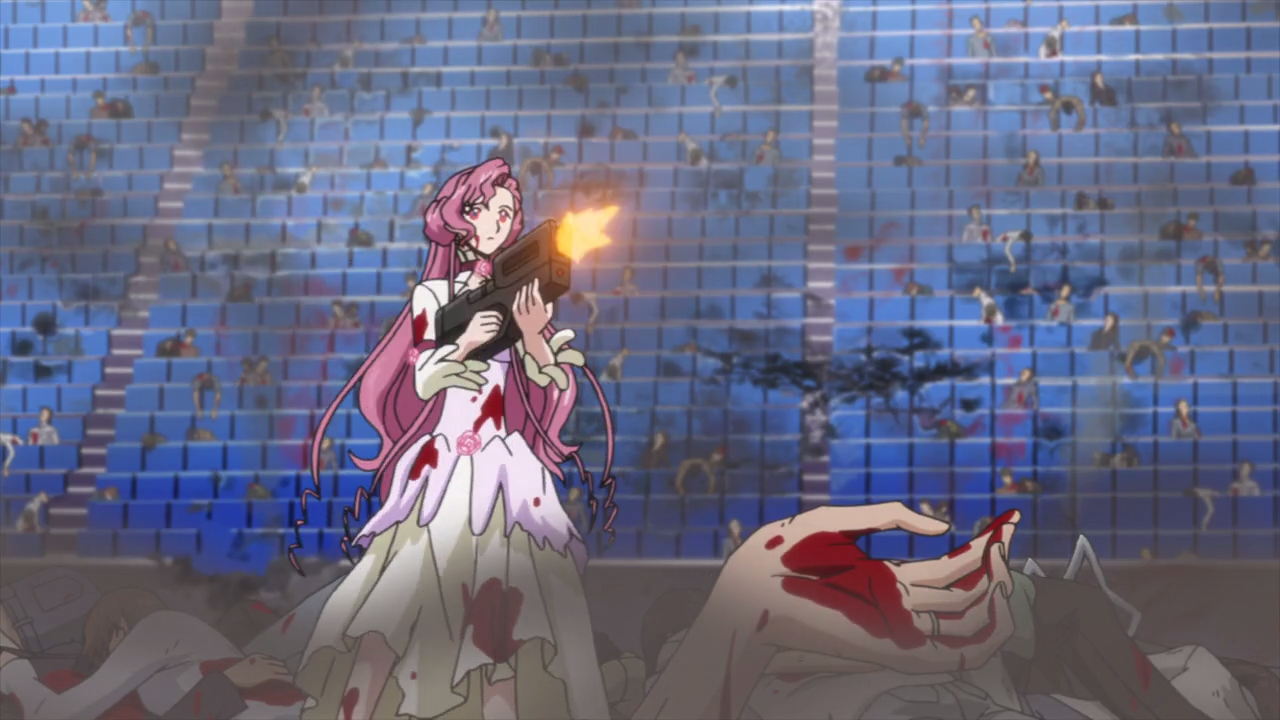
Princess Euphemia is Lelouch's half-sister. Unlike the rest of the Brittanian court, she stresses a pacifist approach to global issues. She ends up paired with Suzaku, becoming his primary love interest. She actually manages to outwit Lelouch, successfully able to broker a diplomatic solution to the conflict involving Brittania and the Japanese insurgents. Lelouch unwittingly uses his Geass on her to order the extermination of all native Japanese citizens, causing her to go on an insane, genocidal massacre with her soldiers.
(Slightly different from peacefully drowning in a river.)
Princess Euphemia dies shortly afterwords, forever known as "Princess Massacre."
While there are a few other minor parallels between Code Geass and Hamlet, they aren't worth going into detail over. The two works explore different themes and wind up with different conclusions--though still share the same space of tragedy. The reason why I compare the two is because Hamlet serves as the starting point for Code Geass to traverse into the themes of National Identity, Genocide, Nuclear War, Insurgency, and other such topics. Since the name of this class is "Hamlet and its aftershocks," I feel its important to observe how people have used the frame of Hamlet to drive forth into new, unexplored territory.
That, and I've watched a lot of Mecha Anime and wanted to write about it for once in class.
Next Week: Random Acts of Hamlet -- Part 2: In Which Hamlet Joins an Outlaw Motorcycle Gang.