For the record: I'll be trying to avoid direct adaptations ala Disney's "The Lion King," as there isn't much that they do with Hamlet, other than recreate it. What I'm looking for are "loose" adaptations, or works with Hamlet-like elements in them that take the conventions of Shakespeare to new territory.
In my first entry, I'd like to start off with the genre of anime, and how Hamlet ends up piloting a giant robot.
Enter 2006's Code Geass
( JIBUN WOOOOOOOOOOOOOOOOOOO)
Vengeance narratives have played a pivitol part in many Japanese stories. Since Shakespeare's Hamlet is considered the go-to narrative when it comes to the political revenge drama, it has become the starting point for many Japanese works. Hamlet, as a character, has played an important role in shaping a protagonist archtype that has appeared in many Japanese plays, television shows, and animes. The characterization of the vengeance-obsessed young man, cold and calculating, struggling with the weight of his own ideals and crafting multiple plots of revenge, has its roots in Hamlet. In many works, Hamlet is the spring board many Japanese writers use to jump characters off into various directions.
Examples of anime characters with Hamlet-like characteristics are far too many to name. Lelouch Lamperouge of Code Geass shows to have the most influence from Hamlet, both in individual characters and overall narrative plot. Of course, Code Geass goes in wildly different directions that have more to do with general Japanese cultural beliefs and things that have appeared in other Mecha genre works.
Anyway, the story of Code Geass takes place in an alternate fictional timeline where military technology has given rise to mechanized super-weapons known as Knightmare Frames (giant robots that do a lot of fancy stuff). The fictional kingdom of Brittania, ruled by an ultra-militarized Social Darwinist ideology, has begun conquest of the rest of the world.
Due to political circumstances that end up killing the Queen of Brittania, the Prince and Princess of Brittania--Lelouch and Nunnally Lamperouge --are exiled to Japan by the order of their father, the King Charles zi Brittania. Haunted by the militaristic actions of his father, and wanting to avenge the death of his mother, Lelouch takes advantage of the national turmoil following Brittania's recent conquest of Japan to take back the throne from the villains who occupy it.
Shenanigans ensue.
And most everyone dies tragically.
I'm not gonna be going into too much detail on said shenanigans. Simply put, too much shenanigans happen. Watch the series for yourself if you're really, really that interested.
Also, if you haven't seen this series and it piques your interest, DO NOT READ THIS BLOG. SPOILER WARNING TO THE MAX. But hey, this series came out like 7 years ago, so yeah.

(The reason why he looks like such a smug, arrogant bastard, is because he is.)
Lelouch (pictured above), shares many similiar characteristics with Hamlet. While many aspects have been switched around or otherwise inverted, both characters are brooding young intellectuals struggling under the weight of their own ideals. Both are obsessed with crafting long, meticulous plots against members of their own court/family, and resolve themselves to murder. Both characters manipulate others to further their own objectives. Another link between the two is the constant intellectual justification they give to their revenge, citing that the wrongs committed by their opponents validate any extreme actions they might take.
Finally, the biggest link between the two lies in the struggle of sanity. Since both Hamlet and Lelouch have to deal with some major political, philosophical, and emotional conflicts, they struggle to maintain a grip on their sanity in the face of it all. I think our discussion of Hamlet's sanity is a bit misguided, as we're all very critical of him during his momentary laps in judgement.
If I were tasked with avenging my father's death with the fate of an entire kingdom hanging in the balance and responsible for a slew of tragic murders, I'm pretty sure I'd have many moments of insanity myself. The fact that Hamlet is able to be as collected as he is even after murdering Palonius and leaving RnG to their pirate-death-fates is remarkable.
Lelouch, by the way, does not do as good of a job as Hamlet at keeping it together while things go down. Where as Hamlet goes from being shakey and unsure to resolute, Lelouch goes in the opposite direction--near the end of the series, he's almost a complete wreck.
There are other characters who draw strong parallels to their Hamlet counterparts, most interestingly in how some characters are divided up into multiple sections.
King Charles vi Brittania plays the Cladius role of Code Geass. They both attain political supremacy through a sordid, treacherous affair that leaves important people (Hamlet's Father / Lelouch's Mother) dead. They both become aware of the protagonist's plot against them and manipulate others against them. And, on some level, they both have the secret knowledge of how wrongful their actions are on the moral spectrum--but at the same time, don't apologize for it.
The main break with Charles and Claudius lies in how the former incorporates more of his character from classical Mecha antagonists than anything else. King Charles is a mix of Gendou Ikari (the terribly abusive father in Neon Genesis Evangelion) with the militant dictatorial zeal found with the Zeon Principality of Mobile Suit Gundam. Claudius wasn't planning on conquering all the nations of the world in order to create a militant Social Darwinist society, nor was he obsessed with distilling all of human consciousness into a single Gestalt being as a means of becoming/replacing God(the latter being a reference to the Human Instrumentality Project from the series Neon Genesis Evangelion).

(Claudius also didn't have whatever the hell this hairstyle is. Then again, this is anime, so silly hair is the norm.)
The Gertrude of the series gets to be a tossup of Lelouch's dead mom and his sister Nunnally. Both invoke the same Oedipal feelings with Lelouch, with Nunnally being considered "off the table" in his quest for revenge. If we make the assumption that part of Hamlet's rage against Claudius is due to his sexual attachments to his mother, then the same can be said of Lelouch's feelings towards Nunnally. Which ends up being a shame when Nunnally reveals how she feels about Lelouch's vengeance quest in Season 2 of the series.
Hint: She isn't supportive of it in the same way we infer Gertrude as.
Hint: She isn't supportive of it in the same way we infer Gertrude as.
The Laertes of the story takes the form of Suzaku, Lelouch's friend who share's his goal, but takes a drastically different approach in attaining it. Laertes and Suzaku share a connection in being the character to directly duel with the Hamlet of their respective story, motivated by their own desire of vengeance following the tragic death of the Ophelia type character. They also share the connection of being able to reconcile with their Hamlet's during the part where everyone dies.
What's intersting in Code Geass is that it inverts the deception aspect between the Hamlet--Laertes characters. In Hamlet, we have Laertes playing to the plot of Claudius' deception, confronting Hamlet with a blade that's secretly poisoned. Laertes, in his dying breaths, confesses to the deception to Hamlet, which causes the latter to go all stab-happy on Claudius. In Code Geass, most of the deception lies on Lelouch's end--Suzaku being more honorable of the two. Suzaku also gets much more development than Laertes, up to the point where he can be considered a second protagonist.
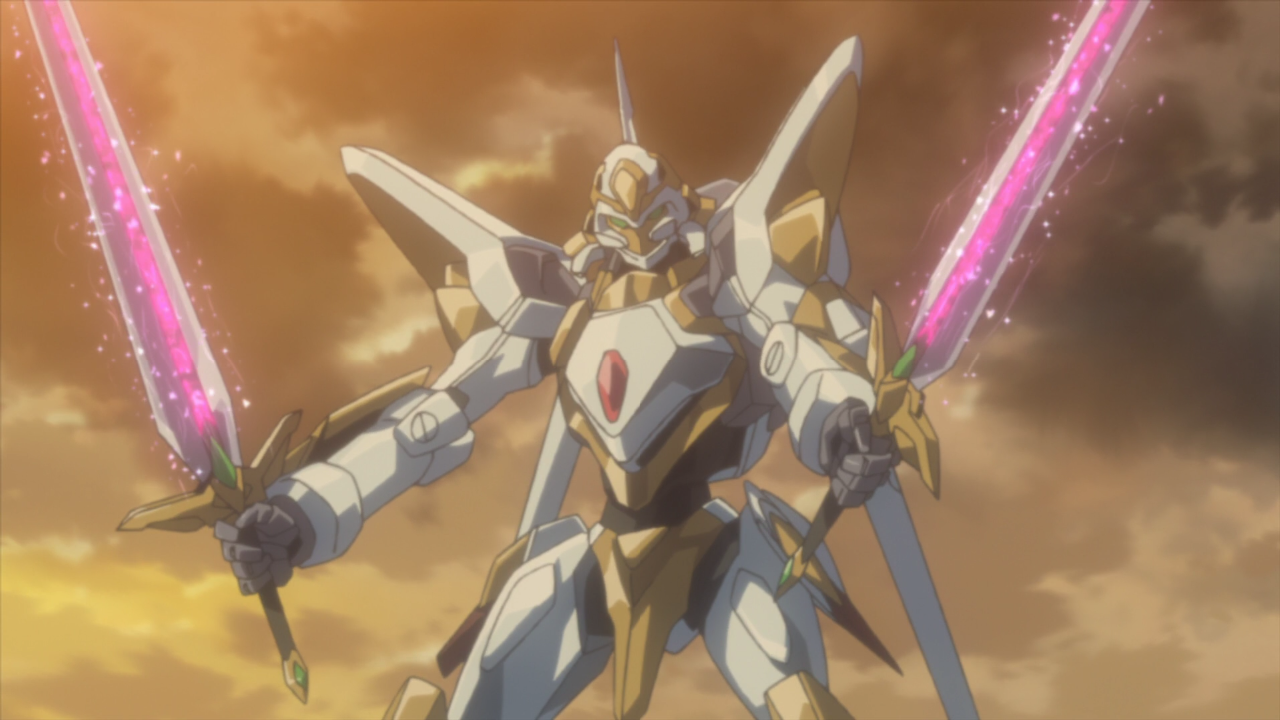
(Suzaku's Knightmare Frame is even called "Lancelot," just in case the rest of his knightly aesthetic goes over your head.)
The Ophelia of Code Geass gets split into two characters, being Euphemia and Shirley. Lelouch, following in Hamlet's footsteps, is terrible to women, doing everything he can to be a manipulative bastard. Both characters meet tragic deaths as a direct result of Lelouch's abusive manipulation and deception. Shirley even has the added bonus of having her father killed directly by Lelouch's actions--something he keeps from her with his magic brain-washing eye thing(the titular Geass, a power that allows Lelouch to make anyone obey a direct order of his--I don't want to get too into detail about it.).
Shirley is a young woman who attends the same school as Lelouch. When he kills her father, Lelouch uses his Geass to wipe her mind. The resulting psychological repression and reversal ends up breaking Shirley's mind. When she re-discovers all of Lelouch's deception, it leads to her tragic death at the hands of another. All of this while she harbors earnest, unrequited feelings of affection for Lelouch.
Princess Euphemia is Lelouch's half-sister. Unlike the rest of the Brittanian court, she stresses a pacifist approach to global issues. She ends up paired with Suzaku, becoming his primary love interest. She actually manages to outwit Lelouch, successfully able to broker a diplomatic solution to the conflict involving Brittania and the Japanese insurgents. Lelouch unwittingly uses his Geass on her to order the extermination of all native Japanese citizens, causing her to go on an insane, genocidal massacre with her soldiers.
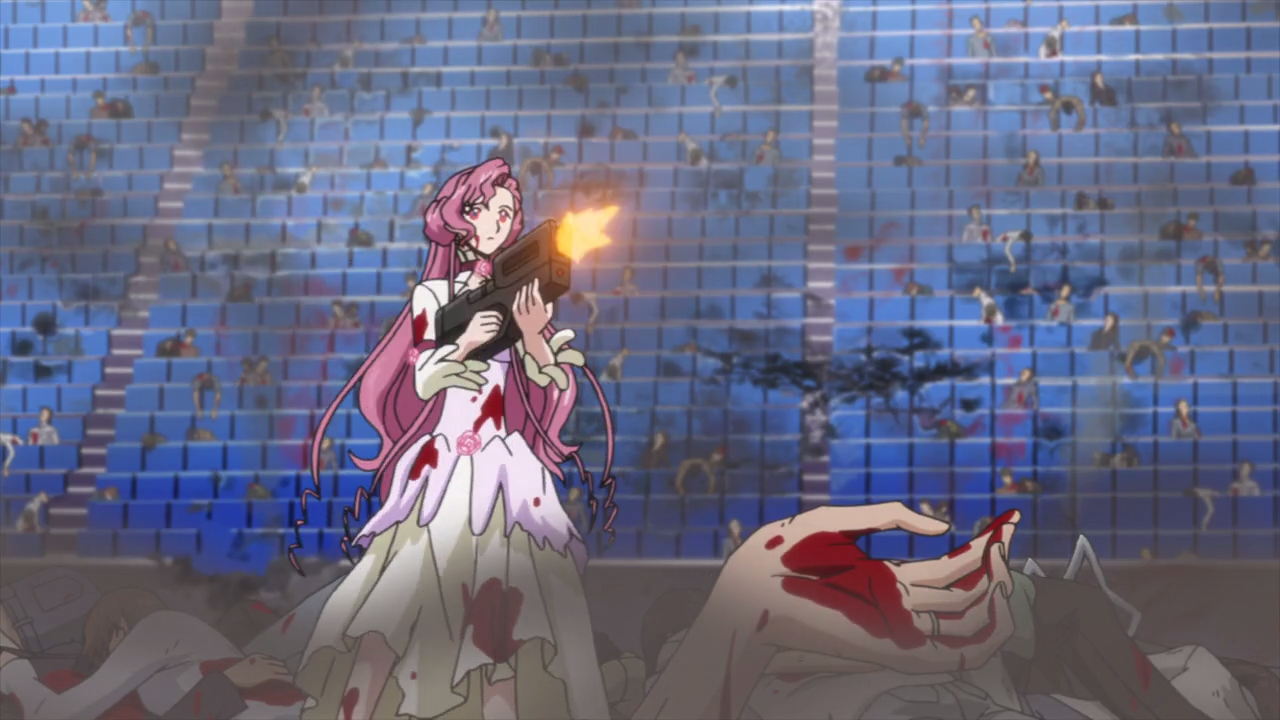
(Slightly different from peacefully drowning in a river.)
Princess Euphemia dies shortly afterwords, forever known as "Princess Massacre."
While there are a few other minor parallels between Code Geass and Hamlet, they aren't worth going into detail over. The two works explore different themes and wind up with different conclusions--though still share the same space of tragedy. The reason why I compare the two is because Hamlet serves as the starting point for Code Geass to traverse into the themes of National Identity, Genocide, Nuclear War, Insurgency, and other such topics. Since the name of this class is "Hamlet and its aftershocks," I feel its important to observe how people have used the frame of Hamlet to drive forth into new, unexplored territory.
That, and I've watched a lot of Mecha Anime and wanted to write about it for once in class.
Next Week: Random Acts of Hamlet -- Part 2: In Which Hamlet Joins an Outlaw Motorcycle Gang.


No comments:
Post a Comment