Showing posts with label Jennifer. Show all posts

Saturday, December 7, 2013

Gertrude is GUILTY

The charge, accomplice in the murder of the king!

I am compiling ideas for my paper and decided to write it down as a blog; I figured I was writing it down anyways, might as well do it here. This will basically be a “working” outline for my paper. I usually don’t do outlines, and just write and change things as I go, but for a 20+ page paper I feel I may benefit from being a bit more organized. Plus any feedback would be much appreciated (but not obligated). Also, I feel my presentation did not go as well as I had hoped…ah well, what done is done. As Disney said, “Keep moving forward!”

Soooo… my thesis… it is a working thesis... I am going to explain in my paper how Shakespeare was influenced by Greek tragedies and Hamlet is a product of these influences. The themes of the Greek plays especially those involving the characters Clytemnestra, Electra, Orestes, Agamemnon, and Aegisthus echo throughout Hamlet. In particular, I plan on focusing on the character Clytemnestra and how she manifests herself in Shakespeare’s character Gertrude. The link between these two characters provide support that Gertrude was at the very least involved in the plot to murder the king. I also plan to gain support with Iris Murdoch’s novel, The Black Prince. Like Agamemnon, Murdoch’s character Arnold commits adultery. When his wife, Rachel, finds out, she is driven to murder. I plan to use this as evidence that like Clytemnestra and Rachel, Gertrude was driven to murder her husband, Hamlet, Sr.

Obviously I need to clean this up a bit, but I think this is the direction I want to go in.

I plan on added textual evidence from Hamlet that mirrors the Greek characters. I have found several critical essays that support the theory that while Shakespeare may not have been able to read Greek, he did have many scholarly friends which may have led to detailed discussions involving Greek plays and their intriguing characters. As a writer there can be no doubt that Shakespeare would have been interested in these subjects.

The other essays I have found will focus on Gertrude’s motives as a woman during that time period, as well as those motives shared by Clytemnestra. I feel there is enough said (and not said) to support the theory of her involvement. The article titled Queen Gertrude: Monarch, Mother, Murderer states the theory that Gertrude uses indirect aggression to achieve her goals. Indirect aggression is a form of passive aggression. It happens typically when a person rebels against another person, a person typically in a placement of high authority. A person who uses indirect aggression usually uses it when they feel powerless in a situation. This theory fits perfectly with all three of the female characters I wish to focus on, Clytemnestra, Rachel, and Gertrude. All three are in submissive roles in society and are victims in their own right. Because of the textual and overt admission of guilt in Clytemnestra’s case, the seemingly obvious witness to Rachel’s guilt, it leads the reader to believe that Gertrude must be guilty as well, even though there is no direct textual evidence and only circumstantial evidence.


I hope this will come together as nicely as I picture it in my head. I am excited to prove Gertrude guilty, even though most critics believe she is innocent. I feel there are too many gaps in her story for us to make sound judgment. I feel there is enough said and not-said to support my theory, and the theory of a few other critics. Plus, I do enjoy playing the devil’s advocate. 

Saturday, November 9, 2013

Bradley’s Hamlet lessons with Julian

On page 152 of The Black Prince, Bradley and Julian discuss Gertrude’s involvement in the King’s murder from Hamlet. Julian feels that Gertrude may have had a hand in the murder with Claudius. She also expresses the idea that Gertrude and Claudius may have had an affair prior to the king’s murder. She states, “I think some women have a nervous urge to commit adultery, especially when they reach a certain age” (Murdoch 152). This hints at the possible link between Gertrude and Julian’s mother, Rachel.

Bradley feels Gertrude is definitely not involved in any way with the murder and did not have any previous relationship with Claudius. Bradley feels Hamlet is Shakespeare (see pages 185-195) and that Hamlet had an Oedipus complex and was a homosexual and involved romantically with Horatio. Bradley quickly dismisses anything negative with Gertrude, likely because of his obsession with his own mother. These Hamlet interruptions in the novel mirror the plotline and foreshadow what is to come. Julian asks, “Why couldn’t Ophelia save Hamlet?” which Bradley responds, “Because, my dear Julian, pure ignorant young girls cannot save complicated neurotic over-educated older men from disaster,” (Murdoch 188). This of course foreshadows Bradley’s demise at the end of the novel, something Julian could not prevent.

Of course, with my adamant feelings regarding Gertrude, I feel Murdoch would agree with me on Gertrude’s involvement in the king’s murder. Sure Bradley disagrees, but Murdoch obviously fashioned Rachel to mirror Gertrude, and Rachel is manipulative and conniving and self-preserving at all and any cost. She even states that “I won’t save [Arnold, her husband,] at the end. I’ll watch him drown. I’ll watch him burn” (Murdoch 33). I feel it is pretty clear that Rachel is a smart, strong woman, which the very same can be said about Gertrude. Gertrude had her own power, and I feel she used that power to allow and influence the downfall of a king.


Is Bradley Pearson a reliable narrator?

Throughout the novel, The Black Prince, I wholeheartedly believed what Bradley told me. As the reader reading a tale in first person I felt I had to believe him. In lying to me he would be lying to himself, and what type of person would do that? I sure wouldn’t! At least not intentionally. There were several times in the novel where I found certain facts a little difficult to believe, the most important would be how Bradley had all those women just begging to get in his pants. He’s self-described and interpreted by the reader as a bitter old man. He describes himself as “thin and tall, just over six feet, fairish and not yet bald, with light fine silky rather faded straight hair. [He has] a bland diffident nervous sensitive face and thin lips and blue eyes” (Murdoch 15-16). That description does not sound very tempting to me, but apparently Rachel (a married woman), Christian (his ex-wife), and Julian (a naïve young woman) just can’t seem to get enough of him and are willing to risk anything and everything to be with him…not to mention Francis hits on him and constantly ties to convince reader and Bradley that Bradley is gay. Bradley’s manic personality change when he falls in love with Julian is also disconcerting to the reader…is he crazy or is he sane (a very Hamlet-like confliction).

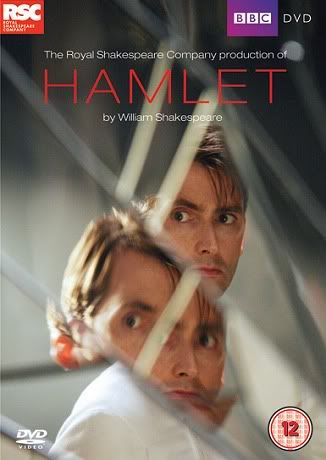
(I like this photo of Hamlet—it shows his shattered self well)

However, it is in the postscripts that I completely lose faith in Bradley’s reliability. He admits that during the trial of Arnold’s Baffin’s murder that (under oath!) he changed his story over and over again: “As the time went on I tried various attitudes, said various things, changed my mind, told the truth, then lied, then broke down, was impassive, then devious, then abject…Perhaps at moments I almost believed that I had killed [Arnold], just as at moments perhaps [Rachel] almost believed that she had not” (Murdoch 374).

It also doesn’t help Bradley’s case that Christian causally discredits him at every turn and Rachel belittles his every account. Julian, possibly the one person the reader could rely on chooses instead to state she cannot accurately recall the change of events that transpired. The readers are left to decide for themselves. Personally, I want to believe Bradley, but I do not feel he’s told me the whole truth…


Monday, September 23, 2013

Euripides and Hamlet

Last semester I took Greek Mythology and I cannot help but see how the play “Electra” by Euripides mirrors the play “Hamlet.” Electra, daughter of Agamemnon (a Greek King), must avenge her father’s ruthless murder. The murderers of the king were his wife, Clytemnestra, and her lover Aegisthus. They plot his death once he returns from fighting the Trojan War.

Electra is hell bent on avenging her father by killing both her mother and her mother’s lover. Her brother, Orestes, is slightly more hesitant about killing his mother, but at the insistence of his sister, he commits the crime. Which is indeed considered a crime by the gods and he is punished furies/harpies until he is judged by Athena. (This is what I remember from class, at least).


As I have frequently mentioned in class, I believe Hamlet’s mother, Gertrude, was connected to the king’s murder—in some fashion at least. Euripides’ play has greatly influenced my perception. Especially since the ghost desperately calls for Claudius’ death, “Revenge [my] foul and most unnatural murder” (28); yet warns Hamlet to “taint not [your] mind, nor let [your] soul contrive / against [your] mother aught. Leave [your mother] to heaven” (30). I feel this is the key to Gertrude’s guilt. It his Hamlet’s father’s warning that even though his mother is guilty, it is not for a son to murder his mother (like Orestes) lest he be damned to be hunted and tormented by demons and spirits (like Orestes). 


Orestes killing his mother (pic).