http://www.youtube.com/watch?v=Qd9ULJf2jqU
Ridin' through this world,
All Alone.
God takes your soul,
You're on your own.
The crow flies straight,
A perfect line.
On the Devil's bed,
Until you die.
Gotta look this life,
In the eye.
Gotta look this life,
In the eye.
I was planning on making this blog post much earlier, however the complexity of the Sons of Anarchy delayed it. Far from being "Hamlet with Motorcycles," the Sons of Anarchy is a complicated meditation on American outlaw culture. Hamlet simply acts as a wire-frame to contemplate the larger issue on what exactly happened to the idealism behind the 1960's rebel outlaw, to the more violent modern image that we know. In other words, Sons of Anarchy is more asking the question "How did we become an 'Easy Rider' to a 'Son of Anarchy,' letting go of idealistic fancies to a colder, darker, more violent realization?"
For the uninitiated, the 1969 movie "Easy Rider" captured the spiritual ideal of an entire generation. By presenting the emerging counter-culture in a positive light, "Easy Rider" was a mega-smash hit of it's time and spoke to the soul of the generation of the time. Peter Fonda and Dennis Hopper starred as two outlaw biker drug-runners, blazing a trail on the road in a search for the American dream. The two characters represented freedom in all of its entirety, cruising through the culture in search for America's ideal.
http://www.youtube.com/watch?v=Cfk4Bqub2Eo
(This is honestly one of the coolest movies ever please go watch it)
Now, the FX series Sons of Anarchy uses both Hamlet and "Easy Rider" as a starting point for it's narrative. The individual story takes direct clues from Shakespeare's Hamlet, introducing the audience to the fictional small town of Charming, California. In the microcosm of Charming, an outlaw gang of motorcyclists known as the Sons of Anarchy rule the town. The Sons (also referred to as 'Sam Crow') are, for all intents and purposes, the ruling body of Charming. They control a lucrative gun-smuggling ring and keep the small-town safe from the more damaging aspects of criminal life.
The reason why the Sons of Anarchy command so much respect, and tolerance, by both the local law enforcement and general population of Charming, lies in their ability to keep drugs, prostitution, and corporate chains out of the small town. The Sons command respect and loyalty within the town because they're able to safeguard the people of Charming from corporate chains and hard crime.
In a way, the Sons are their own little kingdom; there is a whole system of politics, ranging from small business owners to the local police force, that makes up the motorcycle gang's power. Charming, California, is it's own little kingdom; ruled by the ne'er-do-well's of motor-cycle outlaws. The series starts out well within this balance, modelling the structure of an outlaw gang with a direct monarchial rule.
Now, you may be asking, "what in any of this have to do with Shakespeare's Hamlet?"
The answer becomes all too apparent from the very first episode. The entire show of Sons of Anarchy starts within the bare-bones of Hamlet. Jax Teller, the son of the founding "First Nine" member John Teller, celebrates the birth of his own son. Jax's ex-wife is a drug addled crazy-woman, driven to substance abuse and psychosis due to his own terrible behaviors as a man. Jax's mother, Gemma, is happily wed to another "First Nine" founder Clay, the latter having completely taken over the Sons of Anarchy in nearly all regards. Clay calls all the shots, and makes all of the decisions, for the outlaw gang.
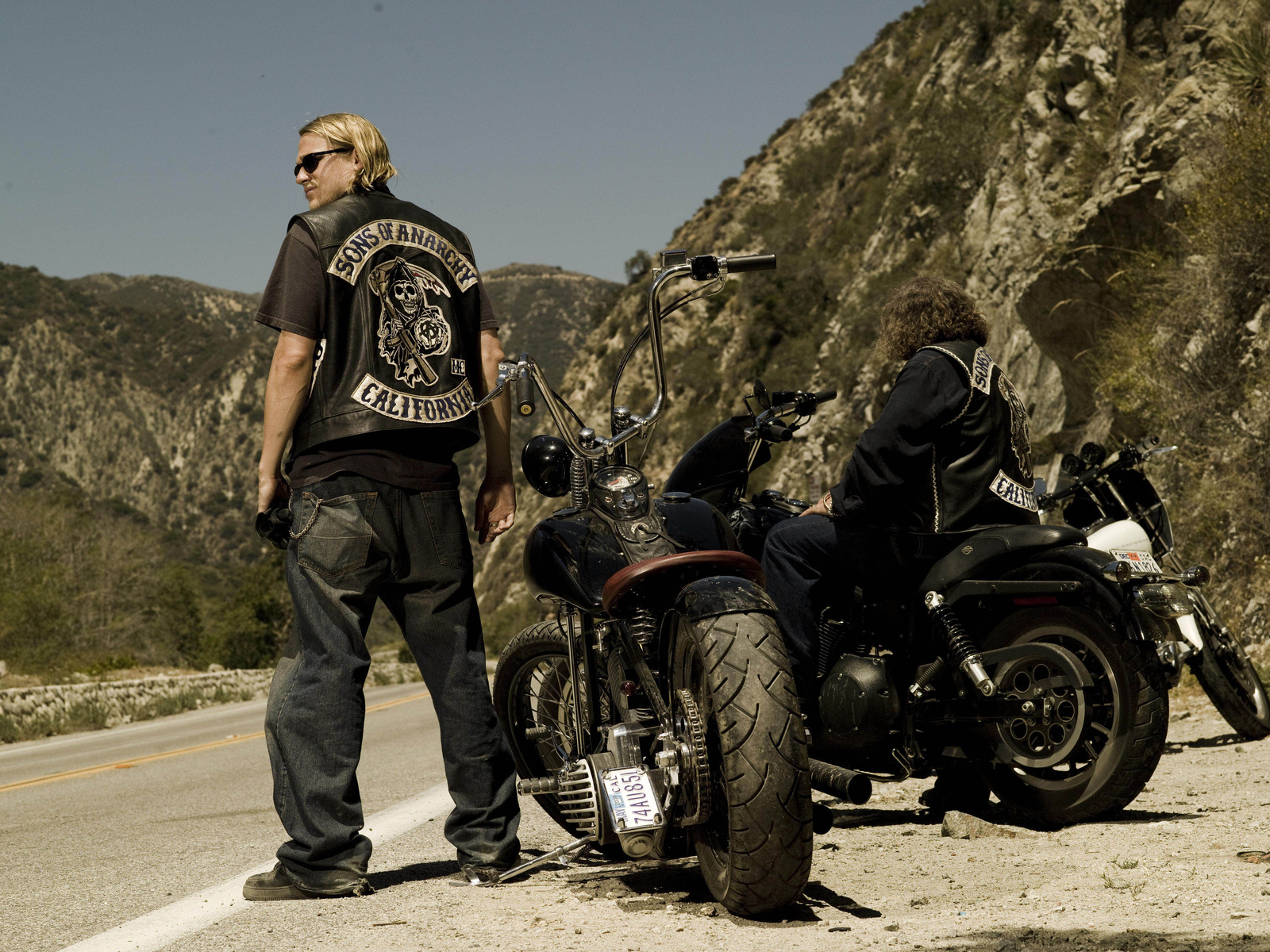
(Pictured above, Jax Teller: The Hamlet of our story.)
At the beginning of the series, Jax is at peace with the whole set up of the Sons of Anarchy. He is totally accepting of the fact that his own mother, Gemma, is the "Old Lady" of Clay. He's even cool with the fact that his father died under mysterious circumstances. Nothing seems to bother Jax much, until the birth of his son--in which Jax begins a bit of introspective, soul-searching exercise.
By chance, Jax uncovers the type-cast for a novel that his father, John Teller has written. The title of the typecast is The Life and Death of Sam Crow: How the Sons of Anarchy Lost Their Way. The type-cast details the entire manifesto of John Teller, explaining the underlying 1960's ideals that founded the Sons of Anarchy as a motorcycle club.
As each episode progresses, John Teller narrates on how the Sons were supposed to be something radically different from what they are under Clay's leadership. The Sons were supposed to be a "Mobile Commune," free-spirited and unbound by traditional law, encapsulating the peace and liberty of the 1960's. John Teller's original vision for the gang was the very image of what Peter Fonda and Dennis Hopper portrayed in "Easy Rider," spreading the hippie ideal of the free spirit.
As the series progresses, Jax learns of his dead father's ideals through the novel-script he left behind, slowly becoming "haunted" by it. His mother, Gemma, even elaborates on this fact in direct dialogue; speaking to her lover Clay on how the "ghost" of John Teller is haunting Jax from beyond the grave. More so, the interaction between Gemma and Clay hint at a larger betrayal; whatever happened between John, Gemma, and Clay, it becomes apparent that the latter two had set up the former in a grand grab for power. In other words, it is strongly hinted at that Gemma and Clay conspired to seize power from John, to guide the Sons of Anarchy in a more profitable, violent, criminal direction.

(Ron Perlman and Katey Sagal as "Clay" and "Gemma," AKA the "Claudius" and "Gertrude" figures)
As the series progresses, the main character Jax becomes more and more disillusioned from what the Sons of Anarchy has become. Referenced as "the prince" of the club multiple times, he begins to move more and more away from Clay's authority, plotting his own path for vengeance. Gemma and Claw become aware of this fact, and fight to try to find a way to cover up the dirty secrets of their past--to no avail. Slowly, Jax listens to the words written in his father's novel, to plot his own revenge against the two people who guided the motorcycle club into a darker path.
Yet, the series itself deals with a whole mess of other issues that stretch far beyond Shakespeare's Hamlet. This is not a simple revenge-narrative, but more a contemplative look at how the ideals of outlaw culture clash against the cold, brutal reality.
How exactly did we go from being "Easy Riders" to "Sons of Anarchy?" Why did the free-spirited hippie have to delve into the darker, more violent, side of life? How can a man both protect his family, while seeking to destroy what it has become? When you're living on the edge of society, how can you hold up higher ideals?
The Sons of Anarchy asks all of these questions, and more, taking the traditional Shakespeare narratives to new directions. While the series starts off in the very familiar Hamlet territory, what transpires between each season asks larger questions on American counter-culture. While we can draw direct parralells between characters (Jax is Hamlet, Gemma is Gertrude, Clay is Claudius, Opie is Horatio, Tiggs is Palonius, Tara is Ophelia, etc etc.) the series takes the form of Hamlet into radical, modern directions.
Where it leads I cannot say--I'm still in season 4 of the show itself. I have not completed it.
Where it leads I cannot say--I'm still in season 4 of the show itself. I have not completed it.
However! I can say that it is a very entertaining show, and worth anyone's time.

No comments:
Post a Comment