One of the articles we had to read was talking about how it would silly to assume that Hamlet was a weakling. And while I don't assume he was a weakling at all, I do believe he was something of a coward. He spends so much of the play in a state of inaction. He refuses to do anything. He decides instead to sit and think, and over-think what he's going to do with the information of his father's death and then the identity of his father's murderer. Hamlet talks a big game but doesn't really do anything about it for 5 acts. I feel like he's actually a very strong character to fully think about whether or not his father's ghost was a true vision or if it was a bad omen from Hell, and he is strong in the sense that he does not completely break from the news of his father's death. But this doesn't mean that he's not a coward.
Hamlet spends 5 acts going back and forth trying to decide if he's going to kill Claudius and when he's going to kill Claudius, and how he's going to kill Claudius, but he never really acts on it until he knows it's his last and only chance. He sits around and sulks and doesn't talk about what's happening internally and doesn't act upon what's happening internally. It seems like he is so worried about the repercussions and what could potentially happen after the fact that he's too afraid to actually do anything. He makes excuses all the time, saying he won't kill Claudius until he knows through Claudius himself that he's the murderer, not just from hearing it through the lips of a ghost. And then he can't kill Claudius when he is in his grasp because Claudius is in a church so he'll go to Heaven if I kill him now. Only when he is dying does Hamlet finally take a stand and kill Claudius. But that doesn't make him any less of a coward. That just continues the idea that he is one. He is only willing to kill Claudius when he knows nothing will happen to him for doing so. Nothing worse can happen to him than Death--I'm sure he doesn't believe he's going to end up in Hell.
Meanwhile he's willing to kill Polonius from behind a curtain. I feel like this is another sign of his cowardice. He cannot see Polonius and Polonius cannot see him, it seems like there will be no repercussions from this killing (though in actuality I'm sure Polonius can surmise who stabbed him, and Gertrude witnessed it). He can also indirectly kill Rosencrantz and Guildenstern, because all he has to do is intercept a letter and send a new one. He doesn't have to spill any blood. Same with Ophelia. He plays a hand in her death but it doesn't seem to weigh on him as much as the idea of killing Claudius does because, well, Hamlet didn't push her into that pond. In every death Hamlet is responsible for, he performs them with such cowardice. It makes me almost mad that a man who is supposed to avenge his father and who could have taken over the throne and one point can't even gather up the courage to kill his father's murderer until it's almost too late.
Intertextuality is a tricky term to get your
head around. I think there are two ways to view intertextuality. The first is
Bloom’s approach – that is, the influence of predecessors can be a source of
anxiety for the artist. The artist is influenced by artists that have already
made their mark, whether they want to be influenced by them or not. Sometimes,
even by actively attempting to avoid the influence of those who came before,
the work of an artist is nevertheless “contaminated” by the greats of the
canon. The second view is summarized by Sanders. Sanders (17) tends to
celebrate intertextuality in a way that allows the artist to freely rethink and
redeploy the work in the canon and interprets such intertextuality through the
lens of post modernism and the post-colonial notion of “hybridity.” Each
approach began with the work of T.S. Eliot, in his famous essay, “Tradition and
the Individual Talent,” first published in 1919.
According to Eliot
(406), writing in 1919, “No poet, no artist of any art, has his complete
meaning alone.” Each artist must be set among his or her predecessors and
attitudes toward it “readjusted” as the “past should be altered by the present
as much as the present is directed by the past.” The way we view artifacts
produced in the past is influenced by what is created by the contemporary
artist. Furthermore, Eliot suggests (407) that “the poet must develop or
procure the consciousness of the past and that he should continue to develop
this consciousness throughout his career.” I think this means that art is not
created in a void – it is created against the backdrop of what has come before
and finds its context within this pre-existing framework: “impressions and
experiences combine in peculiar and unexpected ways” to form new works of art (409).
Bloom develops
this idea further from the 1970s onward. According to Bloom (xix), “great
writing is always at work strongly (or weakly) misreading previous writing.” “Misreading”
means the reading of a text in new ways by artists. This can lead to a certain
amount of anxiety in artists as they attempt to work around the influences that
precede their work. Bloom (xxiii) calls this an “anxiety of influences.” This
means that all writers “misread” the work of their predecessors. As a consequence of this, writers poetically
and creatively interpret, or “misprison,” the work of their predecessors, even
if they do not intend or want to do so. “Misprisonment” means writers resurrect
elements of the work of those that have influenced them. It is in this way,
Bloom’s (xxiv) claim is that many authors have been and continue to be
influenced by Shakespeare. He even goes so far as to call it “this horror of
contamination” when related to Ibsen, who apparently loathed Shakespeare’s
influence. Bloom (xxv) encourages the reader to develop an “awareness of the
anxiety of influence” with regards to Shakespeare so that we might get over resenting
it.
Sanders, writing
more recently in 2006, has a different perspective to that of Bloom’s. The term
“intertextuality” is actually used by Sanders (17). Sanders attempts to explain
the meaning of the term as it is currently used by defining its parts: “adaptation”
and “appropriation.” There are three types of adaptation: the first is
transposition (a screen version of a novel), the second is commentary
(adaptations that comment on the source text), and thirdly, analogue (a
stand-alone work where knowledge of the source text is not essential but such
knowledge may “enrich and deepen our understanding of the new cultural product”
(22)).
Another part of
the meaning of the term “intertextuality” is appropriation. Appropriated texts
are not as clearly acknowledged as adapted texts. There are two broad
categories, according to Sanders (26), of appropriated texts: embedded texts
and sustained appropriations. Embedded texts are more than adaptations, where a
film version of a novel is still, in essence, recognizable as the same story.
An embedded story is a “wholesale rethinking of the terms of the original”
(28). West Side Story is an example
of an embedded text with Shakespeare’s Romeo
and Juliet being reimaged in a 1950s New York City setting. I think that Sons of Anarchy, as mentioned by Tom, could
also be an example of an embedded text.
Sustained
appropriation can be discovered through “examination of sources or creative
borrowings, citing allusions to or redeployments of” the work of predecessors.
It is up to the reader to trace the relationship between a new text and what
may have influenced the new text (34 -5). Our study of Dickens’ Great Expectations helped us to identify
the original materials of the “bricolage”
(17) – similar, I think, to Eliot’s (409) idea that the artists “impressions
and experiences combine in peculiar and unexpected ways” – and that kind of
study forms part of the pleasure of reading a text for the reader. Furthermore,
the artist, from this perspective, is free to embrace the act of creating an
intertext, rather than be anxious about it, as Bloom suggests.
I think that
identifying influence or intertextuality is what good readers do, without prompting.
A good reader is always looking for connections to other texts, ideas, and the
real world. Knowing this process has a name lends formality and legitimacy to
the process. As Allen (6-7) suggests, in comparing a text by authors we read
with those that may have influenced their work, we may arrive at a different
perspective on each of the texts, old and new. Every reader will take something
different away when working through this process. The important thing is that
working through this process when reading makes us pay attention.
Works cited
Allen,
Graham. Intertextuality. 2nd
edition. New York:
Routledge, 2011.
Bloom,
Harold. Preface. The Anxiety of Influence: A
Theory of Poetry. New York, Oxford
UP: 1973; 2nd edition, 1997.
Eliot,
T. S.. “Tradition and the Individual Talent.”
Criticism: Major Statements. Ed.
Charles Kaplan and William Davis.
Boston: Bedford, 2000. 404-410.
Sanders,
Julie. Adaptation and Appropriation.
New York: Routledge, 2006.
I was planning on making this blog post much earlier, however the complexity of the Sons of Anarchy delayed it. Far from being "Hamlet with Motorcycles," the Sons of Anarchy is a complicated meditation on American outlaw culture. Hamlet simply acts as a wire-frame to contemplate the larger issue on what exactly happened to the idealism behind the 1960's rebel outlaw, to the more violent modern image that we know. In other words, Sons of Anarchy is more asking the question "How did we become an 'Easy Rider' to a 'Son of Anarchy,' letting go of idealistic fancies to a colder, darker, more violent realization?"
For the uninitiated, the 1969 movie "Easy Rider" captured the spiritual ideal of an entire generation. By presenting the emerging counter-culture in a positive light, "Easy Rider" was a mega-smash hit of it's time and spoke to the soul of the generation of the time. Peter Fonda and Dennis Hopper starred as two outlaw biker drug-runners, blazing a trail on the road in a search for the American dream. The two characters represented freedom in all of its entirety, cruising through the culture in search for America's ideal.
http://www.youtube.com/watch?v=Cfk4Bqub2Eo
(This is honestly one of the coolest movies ever please go watch it)
Now, the FX series Sons of Anarchy uses both Hamlet and "Easy Rider" as a starting point for it's narrative. The individual story takes direct clues from Shakespeare's Hamlet, introducing the audience to the fictional small town of Charming, California. In the microcosm of Charming, an outlaw gang of motorcyclists known as the Sons of Anarchy rule the town. The Sons (also referred to as 'Sam Crow') are, for all intents and purposes, the ruling body of Charming. They control a lucrative gun-smuggling ring and keep the small-town safe from the more damaging aspects of criminal life.
The reason why the Sons of Anarchy command so much respect, and tolerance, by both the local law enforcement and general population of Charming, lies in their ability to keep drugs, prostitution, and corporate chains out of the small town. The Sons command respect and loyalty within the town because they're able to safeguard the people of Charming from corporate chains and hard crime.
In a way, the Sons are their own little kingdom; there is a whole system of politics, ranging from small business owners to the local police force, that makes up the motorcycle gang's power. Charming, California, is it's own little kingdom; ruled by the ne'er-do-well's of motor-cycle outlaws. The series starts out well within this balance, modelling the structure of an outlaw gang with a direct monarchial rule.
Now, you may be asking, "what in any of this have to do with Shakespeare's Hamlet?"
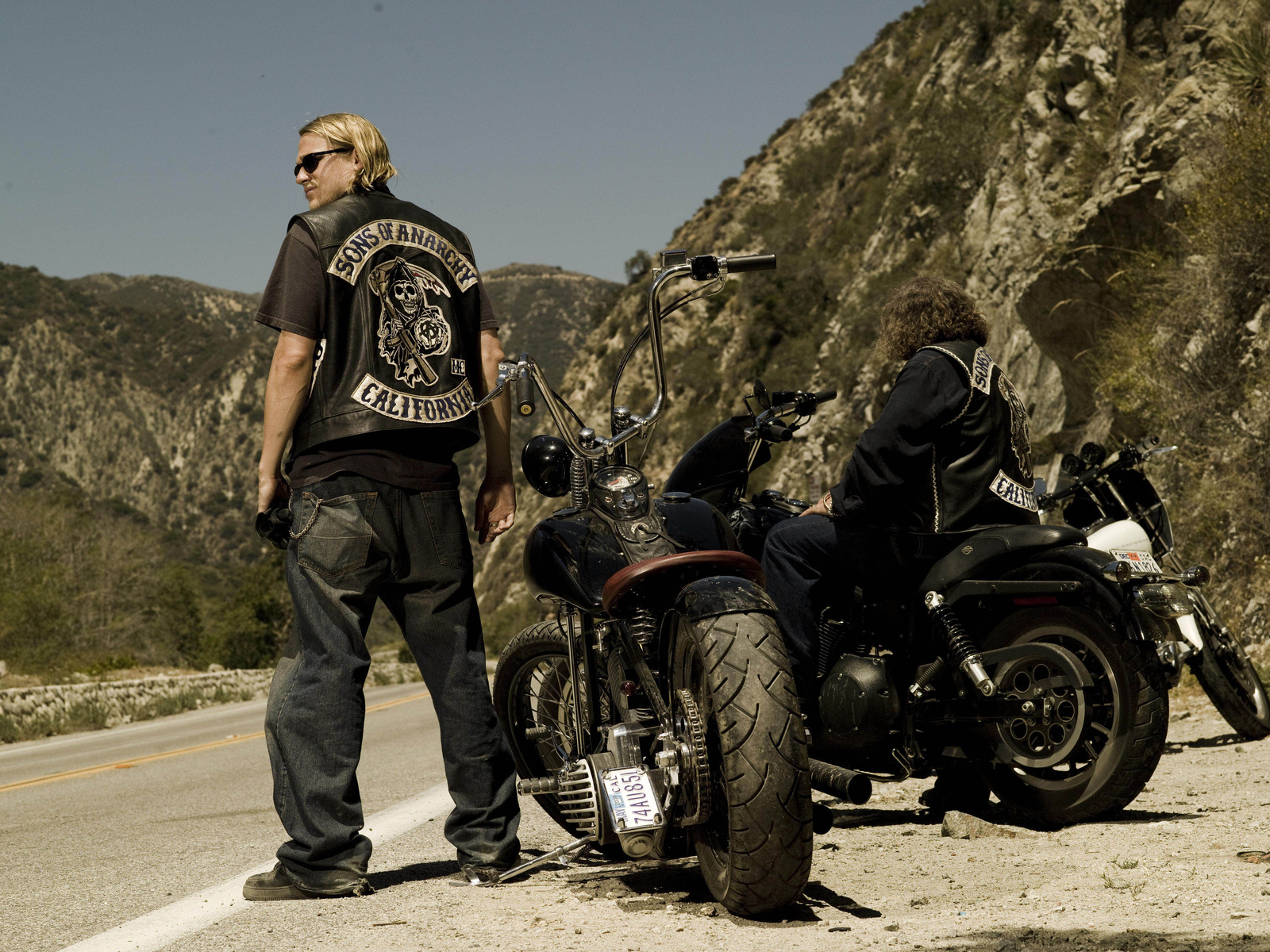
The answer becomes all too apparent from the very first episode. The entire show of Sons of Anarchy starts within the bare-bones of Hamlet. Jax Teller, the son of the founding "First Nine" member John Teller, celebrates the birth of his own son. Jax's ex-wife is a drug addled crazy-woman, driven to substance abuse and psychosis due to his own terrible behaviors as a man. Jax's mother, Gemma, is happily wed to another "First Nine" founder Clay, the latter having completely taken over the Sons of Anarchy in nearly all regards. Clay calls all the shots, and makes all of the decisions, for the outlaw gang.
(Pictured above, Jax Teller: The Hamlet of our story.)
At the beginning of the series, Jax is at peace with the whole set up of the Sons of Anarchy. He is totally accepting of the fact that his own mother, Gemma, is the "Old Lady" of Clay. He's even cool with the fact that his father died under mysterious circumstances. Nothing seems to bother Jax much, until the birth of his son--in which Jax begins a bit of introspective, soul-searching exercise.
By chance, Jax uncovers the type-cast for a novel that his father, John Teller has written. The title of the typecast is The Life and Death of Sam Crow: How the Sons of Anarchy Lost Their Way. The type-cast details the entire manifesto of John Teller, explaining the underlying 1960's ideals that founded the Sons of Anarchy as a motorcycle club.
As each episode progresses, John Teller narrates on how the Sons were supposed to be something radically different from what they are under Clay's leadership. The Sons were supposed to be a "Mobile Commune," free-spirited and unbound by traditional law, encapsulating the peace and liberty of the 1960's. John Teller's original vision for the gang was the very image of what Peter Fonda and Dennis Hopper portrayed in "Easy Rider," spreading the hippie ideal of the free spirit.
As the series progresses, Jax learns of his dead father's ideals through the novel-script he left behind, slowly becoming "haunted" by it. His mother, Gemma, even elaborates on this fact in direct dialogue; speaking to her lover Clay on how the "ghost" of John Teller is haunting Jax from beyond the grave. More so, the interaction between Gemma and Clay hint at a larger betrayal; whatever happened between John, Gemma, and Clay, it becomes apparent that the latter two had set up the former in a grand grab for power. In other words, it is strongly hinted at that Gemma and Clay conspired to seize power from John, to guide the Sons of Anarchy in a more profitable, violent, criminal direction.
(Ron Perlman and Katey Sagal as "Clay" and "Gemma," AKA the "Claudius" and "Gertrude" figures)
As the series progresses, the main character Jax becomes more and more disillusioned from what the Sons of Anarchy has become. Referenced as "the prince" of the club multiple times, he begins to move more and more away from Clay's authority, plotting his own path for vengeance. Gemma and Claw become aware of this fact, and fight to try to find a way to cover up the dirty secrets of their past--to no avail. Slowly, Jax listens to the words written in his father's novel, to plot his own revenge against the two people who guided the motorcycle club into a darker path.
Yet, the series itself deals with a whole mess of other issues that stretch far beyond Shakespeare's Hamlet. This is not a simple revenge-narrative, but more a contemplative look at how the ideals of outlaw culture clash against the cold, brutal reality.
How exactly did we go from being "Easy Riders" to "Sons of Anarchy?" Why did the free-spirited hippie have to delve into the darker, more violent, side of life? How can a man both protect his family, while seeking to destroy what it has become? When you're living on the edge of society, how can you hold up higher ideals?
The Sons of Anarchy asks all of these questions, and more, taking the traditional Shakespeare narratives to new directions. While the series starts off in the very familiar Hamlet territory, what transpires between each season asks larger questions on American counter-culture. While we can draw direct parralells between characters (Jax is Hamlet, Gemma is Gertrude, Clay is Claudius, Opie is Horatio, Tiggs is Palonius, Tara is Ophelia, etc etc.) the series takes the form of Hamlet into radical, modern directions.
Where it leads I cannot say--I'm still in season 4 of the show itself. I have not completed it.
However! I can say that it is a very entertaining show, and worth anyone's time.