Hamlet is an
important play in western culture and has influence in many countries (Bloom). Some
English critics and actors have done a great deal to promote Hamlet within the Shakespeare Industrial
Complex (S.I.C.). The continued perpetuation of the S.I.C. from the seventeenth
century to the present day keeps a lot of academics and theatre companies in
business. It is up to the individual to decide if Shakespeare is really that
good or if we think it is good because a lot of stakeholders in Shakespeare
drama have a strong interest in saying so.
Bloom (81) presents the case that, during the eighteenth
century the Shakespeare Industrial Complex was well underway. This is because, “such
a concentration of dedicated textual critics has never been seen since, and
their efforts helped to turn Shakespeare into England’s preeminent literary
genius.” Critics such as Pope, Steele, Dennis, Warburton, and especially Johnson,
contributed. Of Hamlet in particular, “Farquhar called the play ‘long the
Darling of the English Audience, and like to continue with the same Applause.’”
Indeed, the intensive adoration of Shakespeare from the 1760s onward was so
great that R.W. Babcock called this period the “Genesis of Shakespeare Idolatry”
(85).This may indicate that Hamlet is
a great play because a lot of English critics said it is great.
Not only critics contributed to the S.I.C and Hamlet’s role within it.
Actors such as Betterton and Garrick, who played the Danish prince, were loved
by their public. Each actor benefited from Hamlet. Garrick, in particular, found the promotion of Shakespeare
in terms of a jubilee celebration in the town of Stratford, to be worth his
effort as he amassed lots of money as a Shakespeare actor. He also contributed
to the S.I.C. through supporting the careers of younger Shakespeare actors and
the preservation and the making accessible early versions of Shakespeare (Bloom
85-6). This kind of promotion of Shakespeare not only helped Garrick but also
most likely helped cement the S.I.C.
In the eighteenth and nineteenth centuries, the S.I.C expanded
in new ways. Hazlitt “redefined assumptions about what makes a great tragic
hero” (Bloom 137). Coleridge shifted the focus of Shakespeare’s
characterization from sensibility to philosophy (138). The tenor of critical
focus on Hamlet’s mental state became more technical as psychological study
developed as social scientific field (139).
There are many arguments floating around as to the reasons
behind Shakespeare’s immortality. Some would argue that Shakespeare is great
because of the seemingly explosive and magical combinations of words that he
used. Or perhaps it is his representations of evil, that are irresistible at
times and revolting at others. It could be his ability to mine the human soul
for material that makes him great. However, it is sometimes overlooked that not all of the English were so enamored by Shakespeare’s work. A critic (perhaps Thomas Hanmer) attacked Hamlet for having no good reason to delay his revenge (Bloom 82). Some European critics definitely found Hamlet wanting. Voltaire dismissed Hamlet as a “gross and barbarous piece” (Bloom 83). This could be considered European playwright envy, but this Continental criticism may also have some merit. This indicates again, that perhaps Hamlet is considered good, in part, because a group of English critics said so.
It cannot be denied that Shakespeare is an extreme example
of a playwright. Neither can it be denied that there are many stakeholders in
the business of Shakespeare to the present day. There may be more than even in
the seventeenth century, when every Shakespeare academic, high school English
Literature teacher, actor in companies large and small, is accounted for across
all continents. Maybe it is Shakespeare’s inherent greatness and the
accompanying Industrial Complex in combination that will never let us forget him or his work
and will ensure our discussion of it into the future.
So I've been diligently reading away at Great Expectations, and I admit to a great deal of confusion. I'm failing to see how Hamlet influenced it - at least so far. Perhaps I have just not come to that place in the novel, but I seem to be missing the point. Anyone else in this boat?
I am not missing the influence of Shakespeare in this work. His fingerprints are all over it, from direct references to more subtle touches: in characters and plot points. However, the references seem more like Macbeth to me. I see Pip scrubbing blood from his hands and contemplating his guilt, and I hear Lady Macbeth shouting 'Out out, damned spot!'
Shut up... it's cute and kind of related .
The main elements of Hamlet, at least as I see it, are being haunted by the ghosts of the past, of seeking vengeance, and of a constant struggle between the intellectual mind and the emotional heart. I see so little of these traits in Great Expectations. One might argue that Pip is 'haunted' by the action he took in aiding the escaped convict when he was a child - but at least some of these events were, in part, beneficial to Pip - resulting in his new fortune and so on, for all that it was mismanaged.
Did it occur to anyone else Pip would have had a much nicer life if he became a blacksmith and told Estella to hit the road? I guess money kinda is the root of all evil.
What? I didn't make him get into debt by giving him money he couldn't handle.... Much.
Anyway. I just wanted to see if anyone else was thinking the same thing. If not, well. Maybe you could enlighten me :P
In Defense of Polonius:
Act 1
One of the driving forces behind Shakespeare’s plays, especially so in the case of Hamlet, is the use of language. The way a character is introduced, the lines they’re given and what they actually say in relation to other characters helps the reader to build a picture of that character and assign them the role of hero, villain, victim, or idiot; the list goes on but suffice it to say that these are the main examples being developed in the play.
The figure in Polonius is an interesting one, especially in our class, because of the disapproval that almost everyone voiced about him. Why is that? Does he just not work? Does he work too well or is it simply that you’re all too hard on him?
Let’s find out why.
Act 1, Scene 2 lines 58-60 (page 13 in the Norton)
· Polonius has just been addressed by Claudius and is affirming his sons’ desire to go back to France. This is the first time Polonius appears in the play and his actions are fairly innocuous. Yes, there is interplay earlier between Claudius and Hamlet and Claudius uses Laertes and Polonius to make sure Hamlet knew his place but this is utterly innocent.
Act 1, Scene 3 lines 54-80 (page 21-22 in the Norton)
· Polonius enters the stage after Laertes speaks with Ophelia and gives his son some sage advice. (I have to say that I did not know some of these famous adages came from Hamlet before re-reading it this time.) Polonius gives his son some excellent advice before his send off. Again, he’s the concerned, caring father.
· He says: “This above all—to thine own self be true, and it must follow, as the night the day, thou canst not then be false to any man.”
o This is one of the most wildly debated quotes from Polonius and also the sharp end of the spear used frequently to roast him over the slow fire of criticism. It is not time yet, but I will address this as it continues to re-emerge.
Act 1, Scene 3 lines 89-135(pages 22-24 in the Norton)
· After Laertes leaves, Polonius and Ophelia are on stage together. Polonius counsels/criticizes Ophelia for her relationship with Hamlet (if you could even call it that at this point) and tells her basically that she’s a wailing babe, who doesn’t know any better and can’t, because she is not smart enough to understand the truth of life: sex.
One of the thoughts that has to be developed is the way that he treats his children: Laertes and Ophelia.
One could argue that Polonius is a hypocrite and a fool because he tells Laertes and Ophelia different things but that's the way the cookie crumbles.
A person can be both a loving parent to two different children in two different ways.
Laertes is a man and wise to the world, so Polonius gives him hearty advice.
Ophelia on the other hand is a woman being pursued by a man who Polonius does not like. He tries to order her to stay away from him and tells her that as his daughter, he knows best.
-In effect, Polonius, like a lot of men in the era, is a misogynist. Big surprise. There is nothing inside the text that gives me a sense of idiocy or uselessness.
Thus far, Polonius has shown himself to be a courtier and a father. Does he deserve e at this moment, all of the vitriol and scorn given to him in class?
Last semester I took Greek Mythology and I cannot help but
see how the play “Electra” by Euripides mirrors the play “Hamlet.” Electra,
daughter of Agamemnon (a Greek King), must avenge her father’s ruthless murder.
The murderers of the king were his wife, Clytemnestra, and her lover Aegisthus.
They plot his death once he returns from fighting the Trojan War.
Electra is hell bent on avenging her father by killing both
her mother and her mother’s lover. Her brother, Orestes, is slightly more hesitant
about killing his mother, but at the insistence of his sister, he commits the
crime. Which is indeed considered a crime by the gods and he is punished
furies/harpies until he is judged by Athena. (This is what I remember from
class, at least).
As I have frequently mentioned in class, I believe Hamlet’s
mother, Gertrude, was connected to the king’s murder—in some fashion at least. Euripides’
play has greatly influenced my perception. Especially since the ghost desperately
calls for Claudius’ death, “Revenge [my] foul and most unnatural murder” (28);
yet warns Hamlet to “taint not [your] mind, nor let [your] soul contrive /
against [your] mother aught. Leave [your mother] to heaven” (30). I feel this
is the key to Gertrude’s guilt. It his Hamlet’s father’s warning that even
though his mother is guilty, it is not for a son to murder his mother (like
Orestes) lest he be damned to be hunted and tormented by demons and spirits
(like Orestes).
As we referred to Star Wars multiple times, I feel a bit responsible to share this with you and provide you with some basic thoughts as well as public receptions on it:
(Doescher, Ian (2013): William Shakespeare's Star Wars. Verily, a New Hope. Philadelphia: Quirk Books.)
I stumbled over it about four months ago (to be honest, I found one page of it on 9gag) and I, as well as many others, thought it was amazing. Basically, it is an adaptation of George Lucas' fourth episode of Star Wars into a Shakespearean like Early Modern English play with acts, a chorus, even mostly an iambic parameter, soliloquies by R2D2 and everything else to be quite a lot of fun. In addition to that and almost too obvious to notice is that he changed the type of literature from novel to play. I would not necessarily describe it as a parody of Star Wars but as a fusion of two very popular Authors and their way of storytelling. By approaching that, Doescher faced a huge challenge as well as the readers' great expectations; but see for yourselves:
When I read
these lines, they make me smile, not only for the comment aside but also for
C3PO’s conversation with R2D2 which is probably known by its original. People who read it might enjoy it because of several reasons: It does not just adapt Shakespeare's Early Modern English language, but also stylistic means woven into themes and motives of Lucas. Also, it merges setting and traits of a futuristic science-fiction novel (or movie) with the ones of the Elizabethan age, which creates an interesting and somehow neat charisma.
Particular striking is that the play focuses on a particular kind of audience. Fist, people have to know the Star Wars Saga and some background knowledge. Second, they must have read at least one of Shakespeare's plays and be familiar with at least his most common key motives. Consequential, the play requires its readers to be educated in a certain direction in order to fully understand its jokes, puns and most basic its language. But this seems to be the case for a majority of readers which could provide interesting information about Shakespeare and his perception in our contemporary world: While he belongs to a classic corpus, there it not such a great distance to common fiction as it sometimes appears to be.
P.S. The afterword describes similarities of Star Wars and plays written by Shakespeare. Maybe this would be worth and interesting to have a look at.
I've decided that I want to focus the next few blog entries on the particular theme of intertextuality, in how the narrative elements of Hamlet have transitioned through time, media, and genre. For the next amount of unspecified entries, I'll be using this blog to track how Hamlet appears in the whackiest places, and how its tropes, structure, and archtypes change with them.
For the record: I'll be trying to avoid direct adaptations ala Disney's "The Lion King," as there isn't much that they do with Hamlet, other than recreate it. What I'm looking for are "loose" adaptations, or works with Hamlet-like elements in them that take the conventions of Shakespeare to new territory.
In my first entry, I'd like to start off with the genre of anime, and how Hamlet ends up piloting a giant robot.
Enter 2006's Code Geass
(JIBUN WOOOOOOOOOOOOOOOOOOO)
Vengeance narratives have played a pivitol part in many Japanese stories. Since Shakespeare's Hamlet is considered the go-to narrative when it comes to the political revenge drama, it has become the starting point for many Japanese works. Hamlet, as a character, has played an important role in shaping a protagonist archtype that has appeared in many Japanese plays, television shows, and animes. The characterization of the vengeance-obsessed young man, cold and calculating, struggling with the weight of his own ideals and crafting multiple plots of revenge, has its roots in Hamlet.In many works, Hamlet is the spring board many Japanese writers use to jump characters off into various directions.
Examples of anime characters with Hamlet-like characteristics are far too many to name. Lelouch Lamperouge of Code Geass shows to have the most influence from Hamlet, both in individual characters and overall narrative plot. Of course, Code Geass goes in wildly different directions that have more to do with general Japanese cultural beliefs and things that have appeared in other Mecha genre works.
Anyway, the story of Code Geass takes place in an alternate fictional timeline where military technology has given rise to mechanized super-weapons known as Knightmare Frames (giant robots that do a lot of fancy stuff). The fictional kingdom of Brittania, ruled by an ultra-militarized Social Darwinist ideology, has begun conquest of the rest of the world.
Due to political circumstances that end up killing the Queen of Brittania, the Prince and Princess of Brittania--Lelouch and Nunnally Lamperouge --are exiled to Japan by the order of their father, the King Charles zi Brittania. Haunted by the militaristic actions of his father, and wanting to avenge the death of his mother, Lelouch takes advantage of the national turmoil following Brittania's recent conquest of Japan to take back the throne from the villains who occupy it.
Shenanigans ensue.
And most everyone dies tragically.
I'm not gonna be going into too much detail on said shenanigans. Simply put, too much shenanigans happen. Watch the series for yourself if you're really, really that interested.
Also, if you haven't seen this series and it piques your interest, DO NOT READ THIS BLOG. SPOILER WARNING TO THE MAX. But hey, this series came out like 7 years ago, so yeah.
(The reason why he looks like such a smug, arrogant bastard, is because he is.)
Lelouch (pictured above), shares many similiar characteristics with Hamlet. While many aspects have been switched around or otherwise inverted, both characters are brooding young intellectuals struggling under the weight of their own ideals. Both are obsessed with crafting long, meticulous plots against members of their own court/family, and resolve themselves to murder. Both characters manipulate others to further their own objectives. Another link between the two is the constant intellectual justification they give to their revenge, citing that the wrongs committed by their opponents validate any extreme actions they might take.
Finally, the biggest link between the two lies in the struggle of sanity. Since both Hamlet and Lelouch have to deal with some major political, philosophical, and emotional conflicts, they struggle to maintain a grip on their sanity in the face of it all. I think our discussion of Hamlet's sanity is a bit misguided, as we're all very critical of him during his momentary laps in judgement.
If I were tasked with avenging my father's death with the fate of an entire kingdom hanging in the balance and responsible for a slew of tragic murders, I'm pretty sure I'd have many moments of insanity myself. The fact that Hamlet is able to be as collected as he is even after murdering Palonius and leaving RnG to their pirate-death-fates is remarkable.
Lelouch, by the way, does not do as good of a job as Hamlet at keeping it together while things go down. Where as Hamlet goes from being shakey and unsure to resolute, Lelouch goes in the opposite direction--near the end of the series, he's almost a complete wreck.
There are other characters who draw strong parallels to their Hamlet counterparts, most interestingly in how some characters are divided up into multiple sections.
King Charles vi Brittania plays the Cladius role of Code Geass. They both attain political supremacy through a sordid, treacherous affair that leaves important people (Hamlet's Father / Lelouch's Mother) dead. They both become aware of the protagonist's plot against them and manipulate others against them. And, on some level, they both have the secret knowledge of how wrongful their actions are on the moral spectrum--but at the same time, don't apologize for it.
The main break with Charles and Claudius lies in how the former incorporates more of his character from classical Mecha antagonists than anything else. King Charles is a mix of Gendou Ikari (the terribly abusive father in Neon Genesis Evangelion) with the militant dictatorial zeal found with the Zeon Principality of Mobile Suit Gundam. Claudius wasn't planning on conquering all the nations of the world in order to create a militant Social Darwinist society, nor was he obsessed with distilling all of human consciousness into a single Gestalt being as a means of becoming/replacing God(the latter being a reference to the Human Instrumentality Project from the series Neon Genesis Evangelion).
(Claudius also didn't have whatever the hell this hairstyle is. Then again, this is anime, so silly hair is the norm.)
The Gertrude of the series gets to be a tossup of Lelouch's dead mom and his sister Nunnally. Both invoke the same Oedipal feelings with Lelouch, with Nunnally being considered "off the table" in his quest for revenge. If we make the assumption that part of Hamlet's rage against Claudius is due to his sexual attachments to his mother, then the same can be said of Lelouch's feelings towards Nunnally. Which ends up being a shame when Nunnally reveals how she feels about Lelouch's vengeance quest in Season 2 of the series.
Hint: She isn't supportive of it in the same way we infer Gertrude as.
The Laertes of the story takes the form of Suzaku, Lelouch's friend who share's his goal, but takes a drastically different approach in attaining it. Laertes and Suzaku share a connection in being the character to directly duel with the Hamlet of their respective story, motivated by their own desire of vengeance following the tragic death of the Ophelia type character. They also share the connection of being able to reconcile with their Hamlet's during the part where everyone dies.
What's intersting in Code Geass is that it inverts the deception aspect between the Hamlet--Laertes characters. In Hamlet, we have Laertes playing to the plot of Claudius' deception, confronting Hamlet with a blade that's secretly poisoned. Laertes, in his dying breaths, confesses to the deception to Hamlet, which causes the latter to go all stab-happy on Claudius. In Code Geass, most of the deception lies on Lelouch's end--Suzaku being more honorable of the two. Suzaku also gets much more development than Laertes, up to the point where he can be considered a second protagonist.
(Suzaku's Knightmare Frame is even called "Lancelot," just in case the rest of his knightly aesthetic goes over your head.)
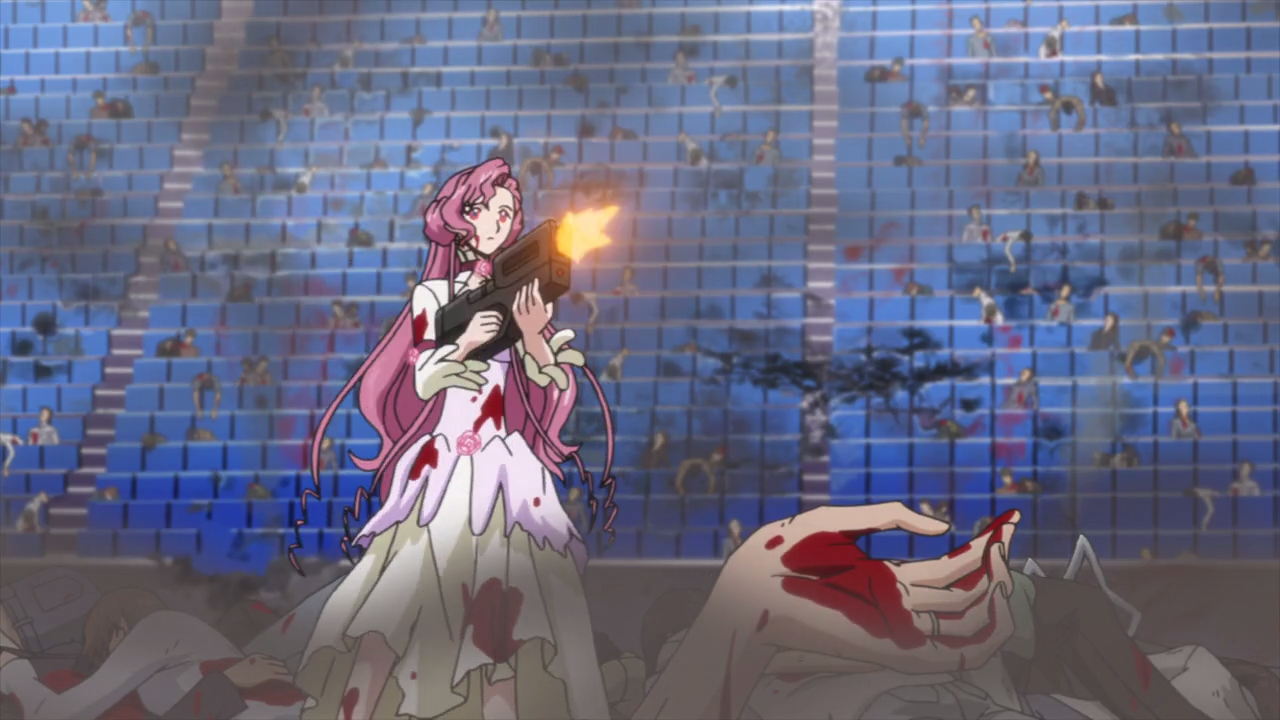
The Ophelia of Code Geass gets split into two characters, being Euphemia and Shirley. Lelouch, following in Hamlet's footsteps, is terrible to women, doing everything he can to be a manipulative bastard. Both characters meet tragic deaths as a direct result of Lelouch's abusive manipulation and deception. Shirley even has the added bonus of having her father killed directly by Lelouch's actions--something he keeps from her with his magic brain-washing eye thing(the titular Geass, a power that allows Lelouch to make anyone obey a direct order of his--I don't want to get too into detail about it.).
Shirley is a young woman who attends the same school as Lelouch. When he kills her father, Lelouch uses his Geass to wipe her mind. The resulting psychological repression and reversal ends up breaking Shirley's mind. When she re-discovers all of Lelouch's deception, it leads to her tragic death at the hands of another. All of this while she harbors earnest, unrequited feelings of affection for Lelouch.
Princess Euphemia is Lelouch's half-sister. Unlike the rest of the Brittanian court, she stresses a pacifist approach to global issues. She ends up paired with Suzaku, becoming his primary love interest. She actually manages to outwit Lelouch, successfully able to broker a diplomatic solution to the conflict involving Brittania and the Japanese insurgents. Lelouch unwittingly uses his Geass on her to order the extermination of all native Japanese citizens, causing her to go on an insane, genocidal massacre with her soldiers.
(Slightly different from peacefully drowning in a river.)
Princess Euphemia dies shortly afterwords, forever known as "Princess Massacre."
While there are a few other minor parallels between Code Geass and Hamlet, they aren't worth going into detail over. The two works explore different themes and wind up with different conclusions--though still share the same space of tragedy. The reason why I compare the two is because Hamlet serves as the starting point for Code Geass to traverse into the themes of National Identity, Genocide, Nuclear War, Insurgency, and other such topics. Since the name of this class is "Hamlet and its aftershocks," I feel its important to observe how people have used the frame of Hamlet to drive forth into new, unexplored territory.
That, and I've watched a lot of Mecha Anime and wanted to write about it for once in class.
Next Week: Random Acts of Hamlet -- Part 2: In Which Hamlet Joins an Outlaw Motorcycle Gang.
While I was browsing Tumblr last week instead of doing my math homework, I stumbled upon an image that was instantly recognizable:
Source: https://www.facebook.com/Voodica
It made me wonder: What is it about suicide, and specifically Ophelia's suicide, that people find so beautiful? Why do people make art of this one character? Something about her obviously lingers in people's minds long after they've finished reading Hamlet. For some reason, Ophelia's ghost haunts artists' minds, a morbid muse who demands that her story be told and retold.
Part of the reason likely stems from the fact that Ophelia's death is artistic. As Gertrude describes Ophelia's death to Laertes, she chooses her words carefully, painting Ophelia's death not as a suicide, but as a beautiful accident. She describes Ophelia's "fantastic garlands.../Of crowflowers, nettles, daisies, and long purples" (167-68) refers to Ophelia's gown as "mermaid-like" (175) as her clothing weighs her down, "heavy with their drink," and pulls her into the water (180). Ophelia's death seems beautiful when described in this manner, not gruesome and miserable as a suicide should be. Even as she dies, Ophelia is surrounded by the flowers that follow her throughout her existence in the play. Ophelia is a beautiful young woman perpetually frozen in time, whose tragically early death and the flowery language used to describe it have left a lasting impression on artists for centuries.
The beginning of Johnson's Shakespeare preface both annoyed me and made a great deal of sense at the same time.... That detractors of Shakespeare argue that he is only revered as a writer because he wrote so long ago is ridiculous, and yet, the fact that he has lasted so long in such a fashion has to show that his work was so excellent and so true to the human condition that it remains an important part of our culture even in the modern era, and perhaps helped shape it in a fundamental way must be true.
Although I admit that Shakespeare is not a pleasure for everyone, I just don't understand the attitude that it is only considered a 'great' part of English literature simply because it is old. That idea seems patently foolish on its face. How can something of such popularity, so studied and examined, so pursued, reinterpreted and scrutinized for so long be seen in this light at all? It is hardly as though Shakespeare is the oldest play-write available to us. We still study the Greek classic tragedies for heavens sake. There are also many contemporary writers of Shakespeare's that have not created such a stir for so long.
Isn't it so that at the end of the day, the words are the thing- and the fact that they still resonate within us after all this time the only important fact in the case?
In both of our discussions on Hamlet, the motive of death was always
present and it seems that it shapes the whole play from the beginning to the
very end. The audience or the reader as well as the characters within the play
are always confronted with mortality. It serves as a threat, as basis for
public discussion as well as for solitary reflections; it is a source of power
and it is able to provide political profits and tragic losses. Death is an
everlasting mystery which is an important aspect within the fictional play as
well as in reality.
Murder frames the storyline of Hamlet: The killing of old Hamlet, the
protagonist’s father, opens the plot and several sub-plots even before the
beginning of the first scene and thereby initiates Hamlets conflict of revenge.
In the end, Claudius and most of the rest of the court are killed either by sword
or by poison (which is also a quite popular while insidious way to kill in the
play) – or both.
Besides descriptions of killing, death is
considered mostly from Hamlets point of view, and he keeps asking himself whether
or whether it is not legitimate to commit suicide, which could end his unbearably
torment and his struggle. His famous expression “to be or not to be” could
stand either for active or passive behavior or for questioning existence in
general. He connects dying with various spiritual and ethnical aspects,
including the aftermath in heaven, hell or in between, supernatural beings like
the ghost or physical remainders of the dead like Yorick’s skull or Ophelia’s
corpse.
Discussions and examination of death seems to
be popular in the 1600s as well as in the following centuries. As it is the
very end (is it?) of our existence, it keeps being interesting through people’s
desire to control it for themselves as well as for others. Its aftermath is a never-ending
riddle for everyone and the fear of uncertainty and mortality keeps us thinking
about it.
Death and all those questions, connected to it
seem to display mortality rates in the early 17th century. Death was
even more unpredictable than it is now, which could be a reason for its
increased concerns. Its confrontation on stage could provide emotional provisions
for people who had to experience it in their daily life.
In our discussion of Rosencrantz and Guildenstern, we talked a lot about their purpose (or lack there of) in the play. To me, RnG were included in the play to create a familiar presence with the audience--an observer for those observing the play. The most important functions I see them having within Hamlet is their presence as listeners.
While I wouldn't say that they're supposed to be a stand-in for the audience (they do not share the reactions that the audience is supposed to have), or an insertion of an "everyman" presence (they're too far up in the social ladder for commoners to identify with), they definitely share an audience-like element within the play.
It is in front of RnG that Hamlet delivers his "What a piece of work is a man!" in front of him, after seeing through their very poorly made disguise. In most of their other scenes, their presence is usually made to reveal the intentions and plans of other characters--first in how Claudius plans to use them as spies against Hamlet, and again when Claudius gives them a letter to have Hamlet executed in England. We may not learn too much about RnG's individual characters, but we do end up learning about other's through them. They even reveal stuff about other characters after they get killed by pirates--we see just how cold-hearted Hamlet has become, and how resolved he is in confronting Claudius.
That, and I think that they've become archtypical characters who have become elevated over the course of media. The pair of inseparable, naive friends have become a stock in many plays, movies, television shows etc etc. Only this time, they command more agency and importance in narratives than before. Where as in Hamlet RnG don't get to do too much of importance, in other mediums they become essential to the plot.
In one such instance, I think R2D2 and C-3PO from "Star Wars" serves how the RnG archtype has evolved. Both sets of characters share similar aspects (they're both inseparable, low on the social-ladder, naive to the larger drama, tasked with transporting important information without knowing exactly why, etc etc), but the droids are much more important than the Danish college-chums. If R2D2 hadn't delivered those Death Star schematics, or opened all those doors, or stopped the trash compactor when he did, everyone in "Star Wars" would be dead and there'd be no story.
We can even see how the RnG archtype gets elevated to protagonist levels, in some media. But I don't want to talk about any of that until we get to Rosencrantz and Guildenstern Are Dead.
To
huddle, or not to huddle? That is the question.
Whether
'tis nobler on the field to call
For
slings and screens with outrageous frequency
Or to
gather round to discuss a play
And by
talking, bleed the clock to death.... (Staples 21)
This passage, from the August 19, 2013, issue of Sports Illustrated, about the trend of
fast offenses in college football, demonstrates the extent to which Hamlet's
soliloquy has become shorthand in Western culture for a dilemma with no real
solution. It has become as applicable to football offensive coordinators as to
soul-searching princes of Denmark.
This particular example seems to work because Staples uses enough
of the structure and language of the original passage that it is immediately
recognizable as an allusion to Shakespeare's work. Shakespeare is master of the
iambic pentameter, in his original soliloquy adding a feminine ending, and
out-iambs Staples like a boss. However, Staples is able to use roughly the same
amount of syllables per line to make his version work.
Staples imitates the language of Shakespeare as much as possible
but changes some of the words from Shakespeare's to his own in order to apply
the passage to an offensive coordinator. Examples of this include changing
"be" to "huddle", "in the mind" to "on the
field", and "And by opposing end them" to "And by talking,
bleed the clock to death...".
Furthermore, Staples' article title, "Too old school?”
complements his re-purposing of Shakespeare. Shakespeare is old school but
still the best - as is, perhaps, the huddle when it comes to handling the
football offensively. This gives the reader an indication of the direction the article may lean in answer to the question posed in the title.
Staples' recognizable use of the structure and language of
Hamlet's soliloquy has the effect of highlighting the offensive coordinator's
dilemma. It shows the reader the intellectual effort required to accommodate
all stakeholders in running an offense. If Shakespeare's "To be or not to
be?" may be interpreted as "To act or not to act?", in Hamlet
seeking revenge for his father, in the same way, Staples' article shows us how
the offensive coordinator can act to coach his players in a hurry-up offense or
not. There are consequences, positive and negative, for not huddling or
huddling on the field - just as Hamlet was weighing up consequences for his
actions in his soliloquy.
Even though referencing Hamlet's famous soliloquy has become a cliché
for dealing with a dilemma in Western societies, I appreciate Staples' use of its
structure and language of it in the context of his article. In comparing
Staples' allusion to Shakespeare's original, I think I can better understand
the seriousness and difficulty of Hamlet's position in 3.1 of Hamlet. This allusion also emphasizes the intellectual difficulty offensive coordinators face in deciding how to run their offenses. However, alluding to this particular piece of Shakespeare's work is getting old and not generally recommended.
Works
cited:
Staples, Andy. "Too Old School?" Sports
Illustrated 19 August 2013: 20-25. Print.
 In the eighteenth and nineteenth centuries, the S.I.C expanded
in new ways. Hazlitt “redefined assumptions about what makes a great tragic
hero” (Bloom 137). Coleridge shifted the focus of Shakespeare’s
characterization from sensibility to philosophy (138). The tenor of critical
focus on Hamlet’s mental state became more technical as psychological study
developed as social scientific field (139).
In the eighteenth and nineteenth centuries, the S.I.C expanded
in new ways. Hazlitt “redefined assumptions about what makes a great tragic
hero” (Bloom 137). Coleridge shifted the focus of Shakespeare’s
characterization from sensibility to philosophy (138). The tenor of critical
focus on Hamlet’s mental state became more technical as psychological study
developed as social scientific field (139).